
September 1977 Tribal Council and Davey Hawley’s Stories

9-10-77 Hays Senior Citizens Center
Susie and I went to the hall in the morning for the quarterly tribal council meeting. There were about 25 people in the hall. Everyone was sitting around the tables drinking coffee and visiting. Most of the people were from the Agency. Mostly tribal employees. Susie visited with Dora Helgeson, and I visited with Davey Hawley for about an hour. We got there at 10:30. At 11:45, Jack Plumage got up to talk. Jack said that there wouldn’t be a meeting today because they didn’t have a quorum of the council. They waited for an hour and none of the other councilmen came. There were six there and they needed seven for the quorum. Jack said that they can’t conduct any business without a quorum, so we’ll hold the meeting this Monday at the Agency. It’s too bad because we had a lengthy agenda. We had a lot of business to take care of. There were hardly any people there from Hays. The only ones I recognized were Kelly Thomas and Davey, who is a councilman.
Jack said that even though they weren’t going to conduct business, he wanted to talk about the council elections that were coming up on November 1st. He said that the nominating petitions were available for the council election. He held up a petition to show everyone and said that people could get them at the tribal office. The candidate’s names have to be posted in each voting district for at least 30 days, so all petitions have to be turned in by September 26. That is the closing date for when we accept candidates. That is the last day to file and pay the $10 entrance fee. Then on Tuesday, September 27 we’ll have a special council meeting dealing with the coming council elections. At this special meeting, we’ll certify the candidates and we’ll select the election judges. So, if you know anyone who wants to be an election judge, let us know. Then a notice of the candidates for council will be sent to each district and this will be posted for 30 days. There will be a polling place in each of the three districts, Hays, Lodge Pole and the Agency. Jack said that each of the election judges would be given a copy of the voting lists, those people eligible to vote in these elections. He said that he brought copies of the voting lists down here to this meeting so if anyone wanted to check and make sure they could vote, they could check this list. He said that these lists would be out to these election judges before the election in November. He said that to be eligible to vote, you had to be 21 years old or older, and you had to be enrolled, on the rolls, tribal or community rolls.
Then Jack talked about the enumeration on the reservation – from the census taken this year which determines by population of Assiniboines and Gros Ventres in each district, how many council representatives can run from each district. How many Gros Ventre and Assiniboine from each district can run, based on the population. The census is based on all Gros Ventre and Assiniboine in each district eligible to vote. The numbers on the enumeration are the Gros Ventre or Assiniboine on those tribal rolls (at least one quarter degree blood – of Gros Ventre and Assiniboine combined) and 21 years old or older. This is the number that determines representation in each district on the tribal roll.
Davey Hawley gave me his copy of the enumeration. They were only given to the councilmen, and he said that I could keep it. Jack read the figures at the meeting.
The Enumeration
Present Assiniboine members on council
Charles ‘Jack” Plumage – River (vacant)
Gilbert Horn – River (vacant)
Jerry Healy – Lodge Pole (vacant)
Donovan Archambault – Lodge Pole
John Allen – River
Randy Perez – River
These are the districts they represent. But as Jack explained it, everyone votes for all of the districts. The voters don’t just vote for their own district; they vote for all of the districts.
Gros Ventre Council Membership
Arnold Plumage – River
Joe Brown – Hays
Davey Hawley – Hays
Frank Cuts the Rope – Hays
Tennyson Boe – River
Joe McConnell – Hays
Totals - District Lodge Pole (59524) River (59526) Hays (59527)
¼ Assiniboine 144 226 41
¼ Gros Ventre 50 205 186
¼ Assiniboine less 5 13 12
¼ Gros Ventre less 5 13 13
Subtotals 204 457 252
Grand Total: 913
Assiniboine: 411 6 representatives 411 divided by 6 = 68.5
Gros Ventre 441 6 representatives 441 divided by 6 = 73.5
Description of enumeration. All members represent eligible voters in each district. In Lodge Pole there are 144 Assiniboine of ¼ degree blood who are 21 and older. In the River district 226 and the Hays district 41. This is the same for the Gros Ventre, 50 in Lodge Pole, 205 in the River District and 186 in Hays.
The final two figures in the column refer to individuals who are less than ¼ degree Assiniboine or Gros Ventre blood, but they are more than ¼ of both Gros Ventre and Assiniboine. They are not on the tribal rolls, but they are on the community rolls and are eligible to vote.
The subtotals refer to the total number of eligible voters from each district, regardless of their tribal enrollment – 204 in Lodge Pole, 457 in River and 252 in Hays. The total number of eligible voters from all the districts is 913. They determine the number of council representatives who could run from each district. There are six Gros Ventre and six Assiniboine on the council. There are a total of 411 Assiniboine in all three districts and with six Assiniboine councilmen, they determined that there is one Assiniboine councilmen for every 68.5 eligible voters. They determined the following representation:
Hays – No representation with 41 Assiniboine (less than 68.5)
River – 226 Assiniboine. 4 representatives
Lodge Pole – 144 Assiniboine. 2 representatives on the council.
Gros Ventre representation:
Lodge Pole – 50 Gros Ventre. No representation. Need 73.5 for one representative.
River – 205 Gros Ventre: 3 / 4 representatives
Hays – 186 Gros Ventre 3 / 2 representatives
The number of representatives in the River and Hays districts has been three each up until this year and the enumeration found a shift in the population with more Gros Ventre living up in the River district and so Hays may be losing and the River gaining a representative on the council of the six Gros Ventre councilmen.
Jack mentioned that there were four positions up for election this year, his own, Arnold Plumage (his brother), Davey Hawley and Gilbert Horn (Jack’s uncle). Davey is not running again.
An interesting aspect of the council which demonstrates the complexity of tribal enrollment is that Jack Plumage is an Assiniboine representative from the River District. His full brother, Arnold, is also from the River District and he is a Gros Ventre representative. They have equal amounts of Gros Ventre and Assiniboine blood and made a choice of tribe that they would be enrolled.
Jack then passed out a copy of a report to the councilmen. Davey also gave me his copy. It is a ‘Report on the Redworm Industry,’ that was put together by Mickey Brockie, a Ft. Belknap Planner. The tribe is investigating going into a tribal business raising redworms or earthworms. They didn’t discuss it. It will be discussed at the meeting on Monday.
He apologized to everyone for not having a quorum. They had a lunch prepared by women from the community and everyone was invited. They had Indian soup, sandwiches, cookies, coffee and tea.
Susie and I were sitting at a table with Davey Hawley, Francis Lamebull (the tribal attorney and Beatrice’s brother) and an Assiniboine councilman that we didn’t know. Francis said that the tribal enrollment was very complicated. In our constitution, it states that an individual with ¼ degree Indian blood is on the community rolls. It was confusing because they were specific about what they meant by ‘Indian.’ They didn’t mean just any tribe. So, in 1959 an amendment was added to the constitution. It defined Indian blood as Gros Ventre or Assiniboine, but no other tribes. It’s real confusing. We have three rolls on the reservation.
Community rolls – to be enrolled on the community rolls, you have to be at least ¼ Gros Ventre or Assiniboine blood, or you can be a combination of Gros Ventre and Assiniboine blood to make ¼ ‘Indian blood’ and still not be either a full ¼ of either Gros Ventre or Assiniboine. There are certain benefits for people on the community rolls, like being able to vote in elections.
Tribal rolls – If you are ¼ degree Gros Ventre blood or more, you are enrolled in the Gros Ventre tribal rolls. If you are ¼ degree Assiniboine blood or more, you can be enrolled in one or the other tribe, but not both. Enrollment on the tribal rolls gives certain benefits for the tribe, like the treaty claims.
Secretarial rolls – then there is a third roll, Secretarial (from Secretary of the Interior). This roll is from Washington DC. To be on the Secretarial roll you have to be ¼ Indian blood from any tribe or tribes. You don’t have to be from any certain tribe. ‘Indian’ here means any tribe. That’s how a lot of people here got on the road crews. There are BIA jobs that can go to anyone on the Secretarial rolls, so long as they’re ¼ Indian blood from any tribe. He was talking about the landless Indians.
It is really confusing. You can be on the Secretarial roll but not the community or tribal rolls. You can be on the community roll but not a tribal roll.
Davey said that there is a case in court now that shows just how complicated this enrollment thing is. And it involves the Gros Ventre Treaty Committee. There was a woman who lived a long time ago. She was ½ Piegan and ¼ Gros Ventre. When the treaty claims came up for the Gros Ventre, there was a woman who was a descendant of this woman who had her blood changed. This woman had about 120 descendants, they were close to being ¼ Gros Ventre, but they were just short for the treaty claims. Well, her descendant, this woman worked for the BIA and she had political pull. She lobbied in Washington DC, and they had this woman’s blood changed from ½ Piegan and ¼ Gros ventre to a full blood Gros Ventre. This was just enough to pull them all over, and now all 120 are enrolled and supposed to get the treaty claim. They are all through the generations from this person, and there’s no way to prove this woman’s blood. This decision went from the Secretary of the Interior to the BIA in Washington DC, then to Canon (the BIA director in Billings) and then to Farmer, the BIA superintendent on Ft. Belknap. And then Farmer told the Gros Ventre Treaty Committee. They went over us. It is in court now. And these people (the 120 descendants) are doing better than me. The Gros Ventre Treaty Committee had to put money aside for them to wait for the decision from the court case. Well, this money was invested, and it is getting interest now, and they got it all. I got about $900. They’ll get about $1300 each.
There’s just no way to prove the amount of Gros Ventre blood in these old people. It can’t be proven one way or the other with these old timers. Let’s say that you and me, Sandy, called each other ‘brother.’ They used to do this. If two men were real close to each other, were real good friends, they would call each other ‘brother.’ Well, when the government came in and started keeping track of the Gros Ventre, these two men would be put down this way. They would be enrolled this way. And there would be no way to prove that they were or weren’t brothers. And this used to happen, too. Katie Longhorse’s brother-in-law and this other man became close friends and they called each other ‘brother.’ This man was a white man. He had red hair and blue eyes. And they enrolled this man as a Gros Ventre. It used to happen, too, that sometimes a baby would be found by a family. In the old times a baby would be left and if a family found it, if it was white or Indian or from what tribe, but they would raise it as Gros Ventre. It would be called an Indian even if it was white and it would be enrolled, too. There would be no way to prove it either way.
Davey said that the BIA was putting Indians into high positions in the BIA. They think it is good to do this so that they can see things from the Indian point of view. This isn’t necessarily good. I think that the white man’s point of view is better in these positions. If we have to deal with Washington DC, we better know how to deal with the white man; we better know how to do things their way if we’re going to get anything done. Another thing, too, is that an Indian doesn’t like to be dominated by another Indian. That’s a truth. It was this way in the old times, too. They had a tough time picking the Gros Ventre chiefs. They had to be real careful to pick a person who was respected by all. It was hard to pick these chiefs. But if it didn’t work out, they got rid of these chiefs real fast. They just got rid of them. We’d get rid of Farmer (the BIA superintendent) in a minute if we could (he’s Blackfoot). He’s not doing anything for us. When we had a white superintendent, we were getting twice as much done. An Indian just doesn’t want another Indian above him. They just don’t like it. I don’t really understand it. They tried to send my brother here as the superintendent. I was on the council at that time, and I thought about it for a long time, but then I said, no. I didn’t want him to be the superintendent here. He has too many relatives here. It was bound to happen sometime. Someone might ask him for a favor, or he might give one of his relatives a favor. It just wouldn’t have been any good. So, I said that I didn’t want him to come here. He had too many relatives here. So finally, he went someplace else. He was superintendent with the Pima and with the Apache. He’s retired now. The Indian is real independent, too. He doesn’t like to take orders from anyone. He’s too independent. If you tell an Indian what to do, they’ll get mad, and they’ll walk off, too. They just put in this self-determination thing. I don’t know how that will work. Davey didn’t sound very positive about it.
Davey said, I complain a lot about taxes just like everyone else, but I don’t really mind. I love America. In some countries, they take a lot more of your salary. It’s not so bad here. I love this country. It’s the best place to be. We’re allowed to complain about our government, too. You know, there are a lot of us who complain about how the government took away so much of our Indian culture. We Gros Ventre lost most of our language and culture and the government is partly responsible. The mission is, too. The mission is responsible for the loss of so much of the Gros Ventre language. They used to punish us for speaking Gros Ventre. If they ever heard us talking Indian, at the mission boarding school, they would wash our mouths out with GI soap. It was the government issue soap, and it was a coarse lye and detergent. They’d make you brush your teeth with this stuff if they caught you speaking Indian. After you have to do this three times, you stopped speaking Indian. There’s no sense to blame anyone. It has already happened. You just have to learn to forgive. They stopped us from beading, and a lot of other culture was lost, because they made us stop practicing a lot of Indian culture. But now they want us to bring it back. It’s too late to bring back much of the Indian culture. It’s hard to figure it out. Why they want us to bring our culture back, I don’t really understand it. There’s really no sense to be bitter, though. I love this country, and I wouldn’t want to be anywhere else. You can complain about the government. If you do this in some other countries, they’d put you against the wall and shoot you. This is a great country we live in. The Ft. Belknap Boarding School at the Agency was responsible for the loss of a lot of Indian culture, like the mission. But the mission did a lot of good things, too.
Davey said that he has been on both the mission and public school board. Now he is just on the mission school board. About 15 years ago, we almost combined the mission and public schools and almost got federal money for the mission school. Since I was on both school boards at the time, I sort of acted like a go between for the schools in working this out. We tried to get all of the grade school kids down to the mission school. All of the Hays kids would go to the mission school for grade school. They were going to make the public school the high school. If we got federal money for the mission school, the nuns would have gotten a salary. The nuns were going for it, too. They would have gone along with the change, and they would have accepted this federal money and the salary. It was just about this time that the nuns had the convent built and they were going to use their salaries to pay off the convent. We almost got it through, but then the people started to fight it. The people were afraid that they would lose the mission if the change happened. They were afraid that over time, the mission would become a public school, and they didn’t want that to happen. So, they fought the change and it didn’t happen.
We almost lost the sisters once. The mother superior wanted to transfer them away from here. They could teach college and could get a good salary for it, too. Their superior wanted them to get this salary, because they had a convent to pay off or something like that. She had them all planned out to teach college and had the positions for them. They didn’t want to leave here, and the people here didn’t want them to leave. First the people here wrote to the superior in Omaha and asked her to leave the sisters here. But she said that the change was already decided and the sisters already had their positions. So, then we told the superior that we were going to charter planes and the Indians from Hays were going to fly to Omaha to see her, and we were going to call the newspapers and tell them all about the story. She didn’t want all of the publicity. It was just a bluff, too. We weren’t going to Omaha. But their superior came to Hays to talk to the community about it. That superior was all business. She was really tough. But when she came here, we talked to her, and we told her that we wanted the sisters to stay. And the sisters said that they wanted to stay. So, the superior decided to keep them here.
Davey said that the mission used to be self-supporting. It used to be a lot different from what it is now. It was self-supporting for a long time. They had a sheep ranch and hay fields, grain and chickens and a garden. Then about 20 years ago, Father Robinson was the priest, and he mismanaged the mission, and it went back into the hole. The mission went into debt, and they brought Father Simoneau back to manage the mission. He got them back out of debt. He gave the mission lease to Ray Williams, and Ray ran the mission farm for quite a few years. After they brought back Father Simoneau, he paid off the mission’s $40,000 debt.
Davey said that when he was in the army during WWII that he heard a lot about bacterial warfare. This wasn’t the first time bacterial warfare was used. It was used here. Blankets were given to the Indians that were infected with smallpox. The Gros Ventre were given these blankets and a lot of them died from it. There were whole clans that died from the smallpox right here in Hays. There were whole families that lived and camped together in certain places. They lived together in the clans. When the smallpox blankets were given to the Gros Ventre, there were whole families that died from it. Some whole clans were wiped out.
Davey said that I should go out to Timber Ridge sometime. As an anthropologist, you would find it real interesting out there. On the north side of the coulees there’s a buffalo jump. You can find a lot of bones, and you can still find a lot of arrowheads. Tuffy has a real good collection of arrowheads, and he found most of them out there at Timber Ridge. And he also has spear points. You should ask Isabelle Werk about it, too. She knows that area real well. They had their homestead right out there at Timber Ridge, and she raised all her children out there. She can tell you a lot about that area. There’s another big buffalo jump in Havre. It is just as you are driving into Havre (from the east). It is one of the most famous buffalo jumps in the plains. People were really digging up the buffalo jumps around here. They were going in with shovels to dig out the artifacts. Finally, Blaine County put a stop to it. Now people can’t dig up these places.

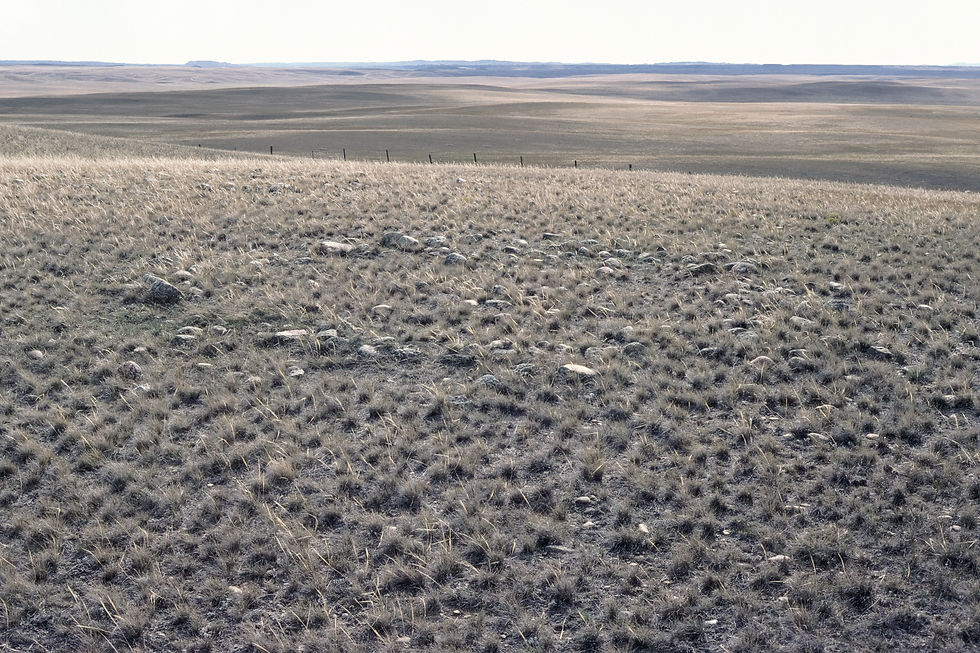
Davey said that there were tipi rings all over the prairie on the reservation, around Lake 17, and down in our area, and out at Timber Ridge and the southwest corner. The stone rings are all over. There are two kinds of tipi rings around here. There are small ones that were the Gros Ventre’s. There are large stone rings from the Shoshone and Cheyenne. I have a lot of small ones near my place. My father-in-law told me about this. The Shoshone and Cheyenne rings are from an earlier time than the Gros Ventre rings. Their tipi rings were larger than ours. Their rings were larger because they were peaceful and they didn’t move so often. So, they could build larger tipis and stayed for a longer time. They started fighting later. There was a lot more fighting when the buffalo became scarce on the plains. But earlier the Shoshone and Cheyenne were peaceful and they lived around here. The Gros Ventre moved all the time and so they had lighter poles and smaller tipis. The Gros Ventre were more warlike, so they moved around all the time. Since they had to be ready to move around so much, they had smaller tipis. We had them around our house. We moved some of them. Boneheads like me just have no respect for these things. We moved them when we built our house. The old timers respected these things. They would have never moved them.


Davey said that the Gros Ventre used to move over a really big area before they were put on the reservation. They moved all the way from southern Canada down to the Missouri River. When the Gros Ventre moved all over this area, they had a practice for dealing with some of the older people. When they moved their camps in the winter, they couldn’t afford to bring along the older people who couldn’t help to support the group and to help get food (food was more scarce in the winter). So, the older people who couldn’t help to support were left behind. Their people would set up good lodges for them for the winter in a place where there was a lot of good grass and water. They’d leave them there in the winter and then they’d come back for these old people in the spring. When they’d come back, there might be only two or three of these old people left. This practice might sound cruel, but they had to do it. These couldn’t afford to travel these long ways in a tough winter with people who couldn’t help to support the group.
Davey said that his term was over on the council this year. I’m not going to run for council this year. I’m getting old and I’m going to leave this stuff for the younger people to do. I don’t have enough patience for it anymore.
Davey said that women’s lib was coming here. It was on the reservation now, and I don’t like it.
Davey said that the tribe was studying the possibility of starting a worm farm. It’s a good business and it takes very little money and effort and not that much space. We could set it up in the builders building. The earthworms can be sold, and you can sell the fertilizer. Davey was excited about it. Davey said that he was trying to sell the idea to his boys so that they could start their own private worm farm at their place.
I told Davey about the mission school board meeting. They decided to charge a $15 fee for utilities and a $30 optional fee for cleaning the gym. Davey said that he could go along with that. I was thinking more like $50 but I’ll go with $45. That’s close enough to what I was thinking. Father Retzel is too soft. He doesn’t get tough enough with these people. It is good to help the poor, but you have to stop somewhere. He’s not helping the people this way. You can’t do everything for them. You have to let people do things for themselves. I warned him about the phone. He just started to let everyone use the phone and he didn’t force people to pay off their phone bills. People make long-distance phone calls everywhere, and a lot of them won’t pay for their phone calls. Now the mission ends up with large phone bills every month from the people making calls and not paying. And people borrow money from the mission, too. He’s too soft to say no to these people. But he’s really not helping them this way. They borrow, $10, $15, $25 and before you know it, a person owes them $400. They leave the mission with a big bill, and the mission can’t collect this money. There’s no way they can get this money back from these people.
Davey said that he went to the mission boarding school and I also went to the Ft. Belknap Boarding School at the Agency for four years. When I first started at the mission school, I only spoke Gros Ventre. I didn’t speak any English. Then I went to the Ft. Belknap Boarding School, after the mission for four years. I didn’t see my parents in all that time. They didn’t come for me for four years. I stayed with some of my other relatives when I was at the Agency. They were Assiniboine and so when I was up there at school at the Agency, I learned to talk Assiniboine. I also learned the Indian sign language when I was at the Agency. My uncle was deaf and he used the Indian sign language, and I learned it from him. So, when I was young, I could speak Gros Ventre and Assiniboine and I knew the sign language.
While I was talking to Davey, Marilyn Bents came over to say hello. Davey said the word “Gros Ventre” and Marilyn said that it should be pronounced without the t sound. She said that the name came from the French and it isn’t what the Gros Ventre called themselves. Davey said that they called themselves, Ainu, the Clay People, the Whiteclay People or the Clay Men. They used a lot of clay. They’d get this white clay, and they’d bake it and would make baked bricks. Then they would break it up and would rub it into their buckskin. The Gros Ventre always had clean white buckskin. They also used it when they painted their faces. They used eisenglass for the same thing, to clean buckskin. It’s a flat rock and they used to crush that and rub it into the buckskin. I don’t know what they called it, but I call it eisenglass.
Marilyn asked Davey if he knew where the name ‘Atsina’ came from. He said that it was the Piegan name for the Gros Ventre. It means the ‘Gut People.’ When the Piegan first saw the Gros Ventre, they must have seen the old ones first, and they had big guts. Marilyn said that she heard that the names Atsina and Gros Ventre were a mistake that they made about the Gros Ventre, the Piegan and the French. She said that the Gros Ventre were known as the “Falls People,” and the sign language for falls was a motion like this – she took both hands and moved them in front of her stomach and down. This could have been confused with motioning that someone was fat or had a big stomach. So, when they did this it was confused as a big belly or gut instead of the falls people. She said that she hates the name Gros Ventre.
Francis Lamebull was sitting at our table. He’s the tribal lawyer and Beatrice’s brother. I asked him where he got his degree and if he had taken any classes in Indian law. He said that he went to school at the University of California in LA. I had only one course in Indian law in all of my schooling, and that was a seminar. We used Felix Cohen’s book on Indian Law. I had to learn Indian Law on my own; it was on the job training. He laughed.


Comments