
September 1977 Albert and Vernie

9-3-77 trailer
Vernie and Albert came to visit. Vernie said that she was back to the Catholic Church. I go to the church up on the hill in LP. I used to go to the Assembly of God Church. I went there for 22 years. There were just a few who went there for years, but those few were really loyal. But I came back to the Church. I was baptized here, at St. Paul’s Mission and I came up to school here when I was just a girl.
9-4-77 Albert and Vernie
Albert and Vernie asked us to come over to show them some of the slides I’d taken on the reservation.
I showed Vernie and Albert a slide of a woman in the Crow parade. Vernie said, oh, that’s an elk’s tooth shirt. They use these front teeth (incisors) and it takes a long time before you get enough. You have to kill a lot of elk to get that many teeth. Then you put these teeth on the shirt. Another slide showed a woman wearing a high crowned hat. Vernie said that was an old-time hat. A lot of people used to wear those.
I showed Vernie a slide of a tipi. She said that there was a certain way that these poles had to be put up. Once some people asked me how to put up a tipi. I don’t know. I watched my grandmother put up tipis. She used to do it, but I never paid close attention when my grandmother did it. I never did learn how to put up the poles.
When I showed Vernie pictures of Glacier Park, she said that her father used to have a good friend who lived in Browning. He was a chief and they named some of the mountains after him, the Chief Mountains. We used to stay up there with this friend of my father’s. There was no water up there then, but now there’s a lot of water. I was always afraid to camp at Glacier, because of all the bears there. They have a lot of mountain sheep there, too. There are so many up there sometimes that they would fill up the roads there. They like to stay up on the high rocks, and they jump from rock to rock. They’re real good at that.
When I showed them the slide of the Crow Round Hall Vernie said, there’s the round hall. That’s an old one. Their halls were always round. Whenever we went down to Crow, that’s always the first thing you’d see coming in there.
Vernie pointed to the mountains across the road from their house. She showed us Brown’s Canyon. She said that the canyon led all the way up to Monument Peak. There was a man who used to work up there in the fire lookout. He used to walk down all the time and would come and visit us.
Vernie said that the Gros Ventre called the mountains, the Fur Cap Mountains. Little Rockies was a name given to them by the white man.
Vernie said that she and Albert have lived up here for 52 years, since 1925. That’s when we moved into our old house (next door to their present home). But then we asked for a new house, and they built it for us, within the last ten years. It’s right next to the old house. We own land, a 480 allotment plus 40 acres here. When my father died, I inherited 100 acres. Most of the others got the rest of it. I only got 100 acres. I’m from Hays. I lived with my parents across the road from where the police station is now. That’s where I lived as a kid. My brother died four years ago in a car accident. He was the last close member of my father left. Now I’m the only one left.
Vernie said that Albert is half Gros Ventre and half Assiniboine. I speak Gros Ventre and Assiniboine and Albert speaks a little Assiniboine. He can say the word for ‘yeah,’ and this is all he says in a conversation. Assiniboine is much easier than Gros Ventre. There are only a few people left who speak Gros Ventre, but there are more that still speak Assiniboine. On Crow, even their kids speak it. Crow is an easy language to learn. You can pick it up real fast.
9-11-77 Brown’s Canyon, the Sandrock Graves and Albert and Vernie’s


We told Albert and Vernie that we would come to visit them this Sunday because they wanted to take us around and show us some places. And then we were going to have lunch. We got to their house at around 11:00. They asked us where we wanted to go, and we told them to take us wherever they wanted.
Vernie said that she knew a lot of good places. There’s a spot back here on our land that Albert saw three or four years ago. It’s a bare spot and there’s some holes around it about a foot deep. We showed a bunch of people that spot and no one knows for sure what it is. You can still see it pretty good. We think it’s where a flying saucer landed. Vernie laughed but she was serious. Then there’s another place on our land where there are rings. They’re real clear. The rocks are sunk down in the ground about like this – she showed about four inches with her hands. Then there’s a grave place where Albert found a man buried with traps. We think it was an old trapper that’s buried there. She asked us if we’ve ever seen the sand rocks. I told her we hadn’t. So, she decided we should go out there. It’s a burial place.
So, we got in the car. Albert drove. Vernie was in the passenger seat and Susie and I sat in the back with Marci. We got onto the Lodge Pole Road and headed west toward the highway. We only went about a mile and then Albert turned off to the left on the south side of the road. I opened a cattle guard, and we drove onto a dirt road and into a field where there were cows. Vernie said that this was tribal land. We passed a big hole (about 20 feet across) and Vernie said that the boys dug that for a reservoir, but it doesn’t hold any water. It’s just a waste of money. But they do this for their training. They’re learning how to use the backhoe.
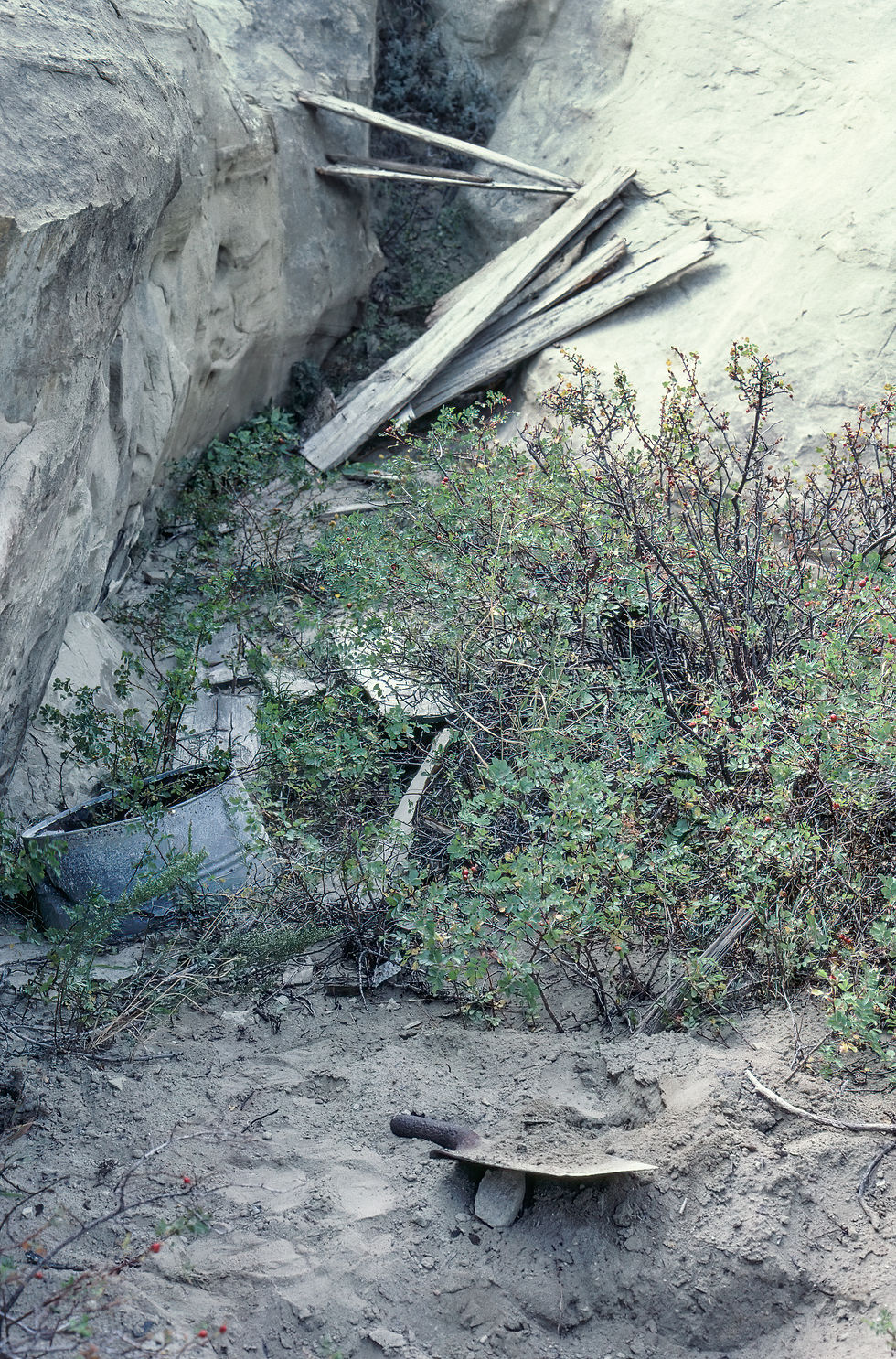
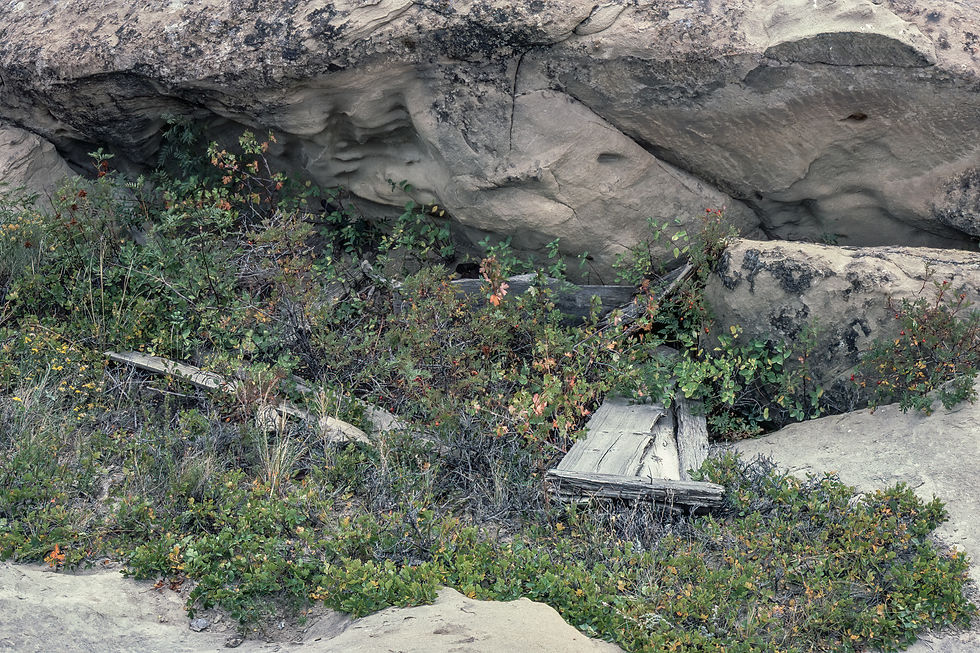
We drove up toward a large butte in this field and at the top of the butte was about 40-70 feet of exposed sandstone. Vernie said that these were Gros Ventre graves and that they were real old. We drove up on top of the butte and Albert parked the car. We walked around the sandstone on top of the butte but Vernie stayed near the car because it was cold and the wind was blowing hard. The sandstone was filled with large and small holes that were cut by the wind and water and were formed in odd shapes. In just about every hole and dug in area, there was a grave. There had originally been bodies placed in a wood box with different items. But the boxes had been badly weathered and only remnants left were boards strewn around on the ground, as were the former contents. The ground was overgrown with brush and other plants and grass. There were bones, bleached white, strewn around the holes, and the wood, bones and items looked as if they had been disturbed by someone or something over time. The items in the pits were beads, metal cups, pots, pans, utensils (a spoon), leather from a saddle and stirrups. There was an old metal sled and a small wagon. All these items were strewn about the pits in no pattern. We walked around the pits for about a half hour. I watched Albert and didn’t do anything until he did. I didn’t want to offend him by breaking a custom or beliefs regarding the graves.
The coffins had been laid on the ground inside of these pits. It was impossible to tell if the items were buried inside or outside of the coffins in the pits. All the boxes were destroyed. There was only one box visible, and it was filled with dirt. Albert said that people were buried like this, in coffins that were laid on the ground. They would be wrapped in a blanket and sometimes they were put on the ground, or they would wrap them in a blanket and put them in a tree. They would be wedged into the trees so they wouldn’t fall out.
At the base of the sandstone but on top of the butte were two graves. The people were buried under the ground. There were two wood crosses that were on the side on the ground, and they were very weathered and gray. They were very old but perhaps more recent than the graves in the sandstone.
Vernie said that the sandrock graves were probably about 100 or 150 years old. Albert said that there were other graves like this – coffins placed on top of the ground – around the area. There was a grave site like this in sandstone about 100 feet from this site to the southeast. And there was another one to the west.






I asked Vernie about the tipi rings. What the rocks were in the center of the circle. She said that those were the fireplaces, where they built their fires. I also asked her what the large pile of rocks were apart from the tipi rings, all by themselves. She said that some people built a special lodge for the medicine man, and then after they were going to leave, they built up rocks like that to show that was where the medicine man slept.
Vernie said that the Gros Ventre used different names for things than what they have now. The names they use now were given by the white man for these different places. The Gros Ventre called Three Buttes, ‘Big Moccasin” and they called Wild Horse Butte, “Little Moccasin.” We called Snake Butte the same name, and Vernie spoke it in Gros Ventre. It’s named because of all the snake dens and rattlers out there. We called the Little Rockies, ‘Fur Cap Mountains.’ The canyon near their house they called ‘Mouse Canyon’ and the one farther away (east of their house in the mountains) is Brown’s Canyon. This canyon is named for Albert’s grandparents – his mother’s parents.
Vernie said that you used to need a permit to leave the reservation. In the old times I can remember that if you were going to leave the reservation, you had to ger a permit (from the BIA superintendent, BIA agent) to leave. And you had to tell them where you were going and how long you would be gone. I don’t ever remember anyone not being able to leave, but everyone who did leave had to get one of these permits. We never went anywhere real far. The farthest away I’ve ever been outside of Montana is once to Arizona and we’ve gone to North Dakota. We’ve been all over Montana though. Last year we went to Arizona. I flew on a plane for the first time. I wasn’t scared at all and I liked it. We went over the Grand Canyon. I hear that’s real pretty, but it was hard to tell from how high up we were. I went to Arizona last year for an all-Indian conference. There were Indians there from all over at this conference.
After we returned from the sand rock graves, we had lunch at Albert and Vernie’s. They served chicken, corn on the cob that Albert grew, potato salad, and jello. Albert also raised the potatoes. Vernie’s granddaughters had prepared lunch for her. They also set the table. Marci told us that she made the jello.
The girls had been beading. Vernie made looms and they bought the beads at Kirkaldie’s store in Lodge Pole. They were following patterns that they get out of magazines on Indian beading. Before we ate, Vernie said a prayer. Her grandson, Nathan, was in a highchair. The girls cleaned up the kitchen.
At the dinner table at lunch, Vernie and Albert spoke to us about the past days on the reservation. The following is a paraphrase of what they told us.
Before the constitution was written on the reservation, how was the tribe run?
Albert said that there used to be council meetings like there are today. The people used to get together for these council meetings. They handled our business. It seems like a lot fewer people ran the reservation in those days. I remember only about three or four people used to run all the tribal business. There was a subagency in Lodge Pole and there was a subagency in Hays. But in the 1930s, they stopped using these and only the agency at the river was left. The Hays agency was where the police station is now. It seems like in those days it was much easier to run the tribal business. Vernie said that she goes up to the Agency sometimes and I look into all those offices, and there’s a clerk in each one of those. I wonder what they’re all doing up there. I don’t think they know either.
Albert, Vernie and I got up from the table and Vernie said that we should leave and go up to Brown’s Canyon. They got ready to leave and their grandchildren started to clean up the kitchen. Marci was sitting on the couch with Susie, and she was showing Susie photo albums so I sat down to look. Most of the pictures were of Vernie’s daughter, and Marci’s mother and father. They live in Alaska. Albert brought over a picture that he had in a brown envelope and showed it to us. He said that this was our booth two years ago at the Midwinter Fair. It was a professional photograph. There was a blue ribbon on their booth. I said, “You won first prize.” Albert smiled.
I think I can remember that the Hays Fair started about 1913 or 1914. It may have been as early as 1910. They had a real good rodeo there. I used to ride saddle broncs in that rodeo all the time. People would come from all over, even Texas, to see the Hays Fair and to ride. Everyone knew about it. There were even a lot of white people who came to the Hays Fair. The horses in the rodeo, the broncs, would come right from the reservation. They’d go out to Three Buttes and they’d catch a bunch of wild horses. There were a lot of wild horses running out there in those days. These horses were sure tough. They’d really bang around in the shoots and after the ride, they’d just let the horses run wild again. Today, they train these broncs. They go right into the shoots. These wild horses they used at the Hays Fair sure gave you a tough ride. It was a big fair, and it seemed to get bigger every year. They had a Ferris wheel there, too. People came from all over. They stopped having the fair around 1935.
I asked Albert and Vernie where they went to school.
Albert said that he went to the mission for only two months. Then I told my parents that I wanted to come home and they came and got me and took me home. I don’t like to talk about it really, but the mission people in those days were real mean. I saw a lot of it myself. A bunch of boys ran away from the school and the Brothers took the boys and lined them up, and then they lined up the older boys, and they had the older boys give the young ones a whipping, taking turns. They’d tell them how many times they wanted each one whipped. They used a buggy whip. The young boys got a buggy whipping. I saw this myself.
Vernie said that she once heard that the kids were beat with a chain, you know, a small link chain. I didn’t see this though. These kids and parents didn’t have any choice about going to the mission school either. They’d come around to the people and they’d take the kids. Sometimes the parents didn’t want the kids to go, because they were too young, and they wanted to wait until they were a little older. They took some kids up to the mission when they were only five years old. But the parents didn’t have a choice. The parents just had to give up the kids. The mission people went around with the police, and they’d come to get the kids and would put them in a wagon and would take them to the mission. And they’d be gone from home for a whole year. There weren’t any vacations. It was a boarding school. We couldn’t even go home for Christmas. Our parents could come to the mission to visit us on Sundays, and they’d come and bring us a basket of food. Things like fruit and berries and bread. But we couldn’t leave the mission. We could go home in June, and we’d be home for June, July and August, but had to go back up there in September. These Ursulines were real mean, and some of the Brothers were like that, too.
We went to school for a half a day at the mission, and then we worked for half a day. They didn’t teach a lot of the things they learn in school today. Most of what we learned was religion. We spent most of our time learning the Old Testament and learning the catechism. We really had to learn that catechism. We spent most of our time on religion. We did learn some other things like geography and arithmetic. They didn’t have math in those days.
Then for a half a day we had to work. We had to clean the rooms and scrub the floors and things like that. The boys had their own building and they used to work over there in their building.
When I first went to the mission boarding school I didn’t speak any English. I didn’t speak a word of English. The older girls who were there longer than me had to be my interpreter. I needed an interpreter to talk to the mission people. But I learned English real fast, and I spoke English real good, too. I spoke English better than a lot of the girls who were older and were there longer than me. I picked it up real fast.
I was well behaved at school, too. I was afraid of getting a whipping and so I always was good. I didn’t want to be punished, and I was scared of it. So, I was always real good. I was always a real small girl. I always have been small.
I was 8 years old when I first went to school. I went to the mission for six years. Then for four years I went to the Ft. Belknap Boarding School at the Agency.
Albert said that he went to the mission for only two months and then I had my parents take me out of the school and bring me home. Then I went to the Ft. Belknap Board School. We went to school for half a day and then worked for half a day. That’s how all the schools worked. That’s how it was at Flandreau, too. I liked the Ft. Belknap Boarding school. They didn’t punish the kids so much. They weren’t so mean as it was at the mission. You didn’t get punished there unless you really deserved it. Then I went to Flandreau Boarding School. I sure liked it there. There were a lot of Indians from all over. There were a lot of Sioux at Flandreau. Each of the Sioux tribes speaks a different language. Assiniboine is a lot like this language, but it’s a little different, too. Sometimes the words were the same. They had a lot of the same words. You said them the same way, but the meanings were different.
Vernie asked me if I thought that I would ever learn Gros Ventre. I told her that I didn’t think so. It is a difficult language to learn. She said, it is a hard language. I can speak Gros Ventre, and I can speak some Assiniboine. Albert doesn’t speak Gros Ventre. Assiniboine is easier than Gros Ventre. In Gros Ventre, there’s a woman’s way of talking and the men talk a different way. That makes it even more tough. Albert used to be able to talk Assiniboine, but he can’t anymore. He can understand Assiniboine when someone talks Assiniboine to him.
I asked Albert and Vernie how long they have been married. How they met. How has marriage changed from the old days?
Vernie said that in the old way, there were men who had more than one wife. My grandmother was one wife and her husband had three other wives. It seems like the wives to one man were either sisters to each other or cousins. The chiefs are the ones who had more than one wife, but most men didn’t. Only the different chiefs had more than one. My grandmother was one of four wives that her husband had. Some of these chiefs had four or five wives.
Albert said that one of these wives was usually a ‘queen.’ This queen was a favorite and she did hardly any work at all. The other wives did the work, getting wood and cutting it, cooking, tanning hides. These other wives did most of the work.
Vernie said that these men didn’t do any work. They just sat around all day. In the old days, these Gros Ventre used to live along the river (Milk River). They lived from Havre to the Bear Paws, down to Great Falls and down to the Missouri River. There was a time when they even lived as far as Ft. Benton. The Gros Ventre lived along the river. When they lived up there, my grandmother was one of four wives and she had a garden. She used to keep a garden and she would plow it. It was hard work for her. And the other wives had to work hard, too, carrying and cutting wood and doing all the work. But the man had a favorite one of his wives, the queen, and she didn’t do much work. He didn’t do much work either. Some of these men would just sit around all day and not do any work.
This ended though. People didn’t have more than one wife anymore. I asked her if it ended when there were no more Gros Ventre chiefs. Vernie said that could be. There weren’t any chiefs anymore after people started going to school. They started getting educations and there were all these other changes and there just weren’t chiefs anymore.
Marriage has sure changed a lot. It used to be for these old timers that if a man wanted to be married to a woman he would take something to the woman’s father, he’d pay for her. And the woman had no decision or choice. If the father took what the man offered for the girl, like a horse or something like that, then the woman had to go with the man and be his wife. If the father accepted it, the girl had no choice. She had to go with the man. But deep inside the girl’s heart she might want to be with another man. She might not want to be with this man deep inside, but she would never say that. She would always keep it inside her. She would never say what she really felt. These girls would keep it all inside and would be married to this man who her father accepted.
Albert and I have been married for 57 years. We’ve never had an anniversary though. Once our kids said they would have a party for us, but they didn’t. We got married on March 23, 1920. I don’t really remember how we met. I guess we just knew each other. Albert said that he didn’t remember either. Well, he used to tease me all the time. Albert was always teasing me. We finally got married. I was 20 years old when we got married. That was old in those days. I always said that I wanted to be an old maid. In the old days, most girls usually got married when they were about 15 years old. Albert was 18 years old when we got married. I was two years older than him. Vernie turned to look at her granddaughters who are about 16 years old. Look at them laughing at the stories I’m telling you. Vernie laughed. It’s not done that way anymore (to her granddaughters). How do you people do it now? You’ll have to ask them about this love thing.
When Albert and I got married, it was real tough. We didn’t move over here until 1925. For about four or five years we lived in Hays near my parents. My parents had their place near where the police station is now in Hays. Their place was across the road from the police station and up the hill there on the flat. Albert built us a log house out there, and that’s where we lived for four or five years after we were married. We couldn’t live here (their present place off of the Lodge Pole road) until Albert was 20 or 21 years old. They wouldn’t let Albert take over his parent’s place (their present land) until he was 20 or 21. So we finally moved out here in 1925. They now live in a newer home that has been built within about the past ten years as a part of the HUD project.
Those days were sure tough on us. It was real hard in those early days. I didn’t know nothing about keeping this place. No one ever taught me anything about what I was supposed to do. I had to learn it on my own. I learned some things at school. When I went to the mission, I learned a few things. But I learned most everything from just doing it on my own. I learned from doing it and from experience. We had to live for a long time on just dried rice. That’s all we had, just dried rice and sometimes bread. And there were times when we didn’t even have tea. Those were hard times. There was no work here. They didn’t have these government programs in those days and there was no work. The old people were the only ones who got rations. If other people got the rations, they had to do work for it. They had to cut wood or something like that. These commodity foods that they have now are something new. Vernie and Albert get commodities.
Albert said, if you had to go up to the Agency, you had to go up there with a team of horses. There weren’t any roads in those days, and it would take two days to get up there. And we used to go in both summer and winter. It was a hard ride up there with no roads.
I asked how people managed to eat and live in those days.
Albert said that in the 1920s there wasn’t work. We would go out to the Bear Paws, and we’d find some work out there on the ranches. We’d do things like cleaning out the barns and corals. There was some ranch work. It wasn’t much, but we could make a little money there.
Vernie said that they used to pick berries a lot too. We’d dry berries and eat them all the time. And we put in gardens. That’s how we got some of our food.
I asked Vernie who was the last Gros Ventre chief. She said that the last chief she could remember was Running Fisher. He was the last Gros Ventre chief.
When we left the house, we walked to an old shed behind the house. Albert, Susie and I went inside. Albert said, this is where I keep my saddles. The shed had four saddles neatly placed on top of saw horses, and there were blankets beneath the saddles, and there were bridles also hanging from nails above the saddles on the wall. There was a chicken sitting on a wide ladder, and there were chickens in the yard. Albert said that he had some good saddle horses and he invited us to come out and ride someday. He said that we could ride through the mountains and go all over. I also have an appaloosa, and I have two Shetland ponies that I keep for the kids. I keep my horses in a field across the road. We left the shed and I saw a large stack of hay bales and I asked Albert if that was his own hay or if he bought it. Albert said that he had a big hay field, and that he had someone come in and cut it. I paid him so much per bale to come in and cut it for me. He didn’t take any hay. He just cut it for me. Behind the haystack there was a large barn, and it was very old with the roof caved in. Albert said that he just couldn’t tear down that old barn. That barn has been here longer than I have. The barn was here before I was even born. The barn was gray and weathered. Then we walked toward their car and Vernie stopped at their fence gate. There was a large horse head painted in black on the white gate and above it were two brands. The one on the right Vernie said was her daughter’s – it was her grandfather’s brand – Albert’s father. The brand on the left was Albert’s – V-8. We got into the car and started out to Brown’s canyon. The mouth of the canyon is on their land and their land runs south all the way to the mountains. The Brown’s Canyon Creek runs through their land, and Albert said that it runs all year round.
Albert said that he puts in a garden almost every year. I have it in a real good spot and it’s real easy for me to water. The creek comes all the way down from Brown’s Canyon and the water runs all year. It’s almost never dry. All I have to do to water the garden is turn the head-gate across the road, and the water runs into the garden. The garden is located just off the Lodge Pole Road and about 50 yards south of their house. We get corn and I planted a lot of potatoes. The red potatoes are coming out real big and the white ones are even bigger. There was a box on the dining room floor, and it was about a quarter way filled with potatoes and onions.
On the way to Brown’s Canyon we drove west on the Lodge Pole Road. We were facing the Bear Paw Mountains. Vernie pointed toward the last butte on the north side. I’ve heard it called McCann Butte. Vernie said that she knew of some Gros Ventre who used to go up on top of that butte for visions and to get power for doctoring and curing. I knew a man who went up on top of Lone Butte and he got his doctoring power up there. He had to stay up on top and fast. His name was Joe Assiniboine. It was Vernie’s father. He cured a lot of people. Albert can testify about that. Albert said that he had pneumonia once and was real sick and he cured me.
There was another butte out in the Bear Paws, Baldy Butte, where people would go to get power. There were a lot of people who couldn’t make it up there. They’d stay there for a while fasting and then they’d hear a real scary noise, and they’d come down. This happened a few times, and then there was a young man. He thought he was real brave, and he was going to go up there for power and find out what the noise was. So, he went up on top and he heard the noise, but he stayed up there. Then he saw a great big rattle snake. The noise was those big rattles. He got scared and he came back down. Some people would go to Eagle Child to have these visions and get their curing power, but a lot of people didn’t stay up there. They couldn’t make it and they came down. These people can’t have the curing power. You have to stay up on top and fast and have an animal come and tell you how and what to do, they give you and tell you about the medicines to use, and the special rules. If they don’t stay up there on top, then they can’t doctor and they don’t get another chance. They won’t go back up on top.
I asked Vernie how much land they had. She said it was about 1600-1700 acres. She said that they don’t get any pension or social security either. We asked for it, but they told them that they had to quit fooling around with cows then if they wanted social security. Albert said that he would rather work for a living, because if you just sit around and get paid, you’ll dry up. He said that there are a lot of people younger than him who have been getting their checks for a long time now, but he said that he’d rather work than sit around and do nothing.
After lunch we took a ride up into the canyon across from Albert and Vernie’s house. Albert had it all fenced off. They said that the whole reservation used to be one big pasture area. But around the 1930s they started to fence it off. Before everyone would just run their cows anywhere and they used to have big round ups so they could brand the cows. But now people have to pay to run their animals on someone else’s land. They both agreed that they liked it better before it was all fenced in. Albert had three gates before we got to the canyon. As we entered the last gate, he said that this was where he ran his cows in the winter because it is a real good grass field. Vernie said that there used to be a lot of deer here too. They would come down out of the canyon, and they would eat his grass, and they really liked alfalfa. We got to one part in the field where Vernie and Albert told us that once there were two bulls that belonged to Buddy Campbell. They had wandered up to the top of these cliffs here, and they had no way to get down, so they leaped from the top of the mountain down to the ground. They said that they saw them jump. One of the bulls broke its leg and the other one really bawled when it jumped off because it must have known that it was jumping to its death. Buddy came out and butchered them, and he gave us one of them. They told us about one time when their cows were on the road. Someone hit one of the cows at night, but the guy was so honest he came in and told them about it. They butchered it and bled it, and they gave him part of the meat.
Albert, Vernie, Marci, Susie and I got to the picnic area in the canyon. The road ended there but there was a trail that you could walk. Albert and I took the trail and Vernie, Susie and Marci stayed back. Vernie said that this used to be a good road, but the floods kept washing it out, and no one comes around to repair it. Vernie stopped and looked around at all of the plants on the path. She pointed to one. It had a red stem and white berry. She said that this is dogwood, but they called it Red Willow, and old Indians used to use it a lot. They would grind it up and mix it with tobacco. Then she pointed to a plant that was low to the ground. She said that this was raspberry, and the Oklahoma Indians made tea out of the leaves of the raspberry. She said that she came out here this summer to look for some berries on them, and they didn’t even have blossoms. She didn’t know why. I asked her if they used peppermint for anything. She said that it was used for a kind of medicine and also if someone had a headache, they would take the peppermint and they would inhale it, and they would keep inhaling it and their headache would go away. Then she picked some leaves off a tree, and she said that these leaves were good for marking places in books. She used to mark places in her bible. She said that she also uses butterflies to mark her pages. Old Indians used to make perfume. They would combine three different plants, one of them was sweetgrass. She said that she went up into mission canyon to get some sweetgrass this year. It grows up in the canyon near the picnic area. But she was too late and it was already turning to its fall colors. You have to pick it when it is green so you can braid it, and then they used some kind of plant, it looks something like celery and it smells like it too. She doesn’t know what the name of it is and she has never found it, but she knows what it looks like. And they used another plant, too. And they would mix all of these up and they would make a perfume. She said that her mom used to do that all the time.
Vernie looked out over the reservation and to the north she saw the haze coming up from the fields to the north. She said that this is really Indian summer we’re having here. It’s hazy out by the Bear Paws. That’s how you know it’s Indian Summer. The haze was from dust and dirt coming up from the fields that were being harvested with big combines on the reservation.
I asked Vernie if people were superstitious. She said that they were. They used to believe a lot in their dreams, and they had some signs, like it was bad luck for an owl to land on your land, or stay around your house, or keep coming around. She said that she never did believe it, but it happened to her. One night she was all alone, and she decided to go out and weed the garden to give her something to do. But it got dark and late, so she decided to go home. On the way back to the house, an owl swooped down over her head and really scared her. She ran and it followed her all the way home. She got in the door, and she ran over to the west window, and she saw the owl circle their house twice. Then right after that, she was almost killed in a bad car accident. She said that another bad sign is a dog howling. It is the same with that. It is just bad luck. It means that something bad will happen to someone in your family.
Vernie said that she remembers when all the children at the beginning of the year right after thrashing time would have to empty their mattresses out and get rid of the old straw and they would have to haul them over to the place where they raised grain, and would get their mattresses filled with new straw. They slept on metal framed beds with these straw mattresses. She said that she must have thought that she was sleeping on a good bed at the time. This was at the mission school.
She said that she can remember when the nuns would take them out into the mountains and make them fill up their gunny sacks full of pine cones to start their fires with. They didn’t have electricity and gas then. Vernie said that even in her home she cooked on a wood stove, and they heated their place by burning wood. I asked her what they ate when she was young. She said by that time, they already had commodities, she had rice and beans and things like that.
Vernie said that the old Indians used to say that the sun was made out of rocks that got so hot that they glowed like that. But she said that scientists today believe that it is made out of hot gases. She said that she would like to know where the heat comes from in the first place. I have seen both a solar and a lunar eclipse. I really liked to watch that. Once some scientists told us to look outside and for three nights we would see falling stars. We looked out and we saw them. They were like regular shooting stars. They go across the sky, but these were falling from a high start lower and lower to stars underneath them. They just kept falling down like that, not from across the sky like usual. I was watching them right by the big dipper. They call it the North Dipper, because at night if you are very lost, you know that you can look up and see the big dipper, and you will know that it is in the north. So, you can always find your way somewhere if you know that. That is why they call it the North Dipper. I also once saw a comet, a star with a burning tail. I was at the mission school and was a little girl when I saw that. It was the only one I ever saw. The shooting stars happen sometimes in the early 40s because she remembered that one of her daughters was at Flandreau at the time and all of the children were out watching them and girls were screaming and yelling and crying because they learned that when the stars start falling and it turns dark that it will be the end of the world. And these girls really thought that it would be the end of the world and they were really scared. Once I was at the mission school and there was a tornado in the sky. The nuns had all the children out in the yard praying about that thing in the sky and it never did land here, but it was really scary.
Albert said that there’s a lot about the old days that he and Vernie didn’t know or remember. We don’t remember a lot of things about the old ways. We came just at the tail end of those days. We were real young then. So, there’s a lot we don’t know about those days. Vernie said that there weren’t many people around now who could tell me about the old days. There are very few people who are still around who could tell you about those old times. Bob Mount’s about the oldest Gros Ventre around now. He’d be able to tell you a lot. He’s an old man and he knows a lot about those times. He could tell you a lot about the mission, too, in those early times. He tells a lot of stories about the early mission. But he won’t tell a lot of people. They want him to come down to the mission and to talk Gros Ventre, but he wouldn’t come down. He wouldn’t do it.
Vernie said that she used to come up here when she was younger and would help Albert cut down the timber from these mountains. Right here. Everyone else would ride up in their cart with a horse pulling it. I was too scared that my horse would slip backward or something, because it was really steep, so I used to walk and lead my horse up.
Vernie was telling us that one time she had gone out to help someone weed their potato garden. She was the only one out there, and she thought she would be a big help and weed all of the garden, and so she pulled up all of what she thought were weeds. It turned out that she had pulled out all of his potatoes. But he didn’t say anything to her. He guessed that she had never seen what a potato was supposed to look like. Vernie said that she used to be real fast at picking potatoes.
Vernie said that they used to raise pigs. There was a log house next to us and some of the Matador cowboys lived there. They told me that I should go south to Tennessee and enter one of the hog calling contests. She did a loud call. They used to tell me that they could hear me calling the pigs when they were way out in the fields. They said that they were sure I would win. Vernie laughed.
On the way to Brown’s Canyon, we passed by a stand of june berry bushes. Vernie said that in some years these berries are as big as grapes. I picked a lot of june berries this year and I put them up in jars. I used to dry them, but in jars they come out more fresh and ready to use. I’ve put them into small plastic bags and put them into the deep freeze before. Along the fence to our house, we have a whole bunch of new berry bushes. I told my grandchildren not to break off any of the branches, cause that kills the berry bushes.
Albert said that one of the problems with going to the canyon was that we had to go through 3 fences. I took down two fences and on the third fence, Albert got out to help me. He had gloves on and I didn’t. The barbed wire was wrapped around the top wire besides the loop around the pole. Albert said that this was done because the cows rubbed on this pole and they would knock it down if he didn’t wrap it like this. Albert said that he had a lot of fence out in these fields (there were about three or four fields on the south side of the road; they have another field on the north side of the road, west of the house). Albert said that he put in most of this fence himself, but sometimes he got a little help. I asked him if he used a post hole digger and he said no, that he pounded the fence posts in.
Albert said that he runs 125 head of cattle. I asked him when he does his branding. He said that he usually brands in late April or in early May. Sometimes we brand even later than that if there are some late calves. This year I lost 15 calves. I lost them in that storm in April. They were in the brush behind our house, and we had all that snow. They were real small then, and they got caught out there by the brush and they died. When we were in the field next to the mountains, Albert said that he winters his cows here, because it is real good grass. Then later in the winter, I feed them out here. If the weather gets real bad, I bring the cows up to the field next to the house. It makes it easier to feed them. Albert said that all this land was open range at one time. It’s been in the last 40 years that people started fencing off all this land. Vernie said that just about the whole reservation was fenced off into units. They’ll have almost the whole reservation fenced into units pretty soon. In those days when it was open range, there would be big roundups. They’d have to round up all the calves in the spring for branding. Albert said that he liked it better when it wasn’t fenced, when it was open range. It was better back then. There weren’t so many fights about land like there is now. In those days, you just ran your cattle wherever you wanted.
Vernie said that these people come out here every summer from the east. They come to get rocks from the Canyon. They come from some university in Michigan. I forget what they call them. I asked Vernie if they were geologists. She said, that’s it. That’s what they were. Then we got some of these people from Colorado one summer who came out to get rocks from the canyon. I don’t know what they wanted these rocks for. Albert repeated, we don’t know why these people want rocks from the canyon.
We passed a part of the Little Rockies that had a large wall of limestone rock exposed and facing north. It was a sheer cliff. Vernie said that this rock was mined by a company from Chinook at one time to make sugar. There was a sugar beet place up in Chinook that made sugar from all the beet farms around here. They paid the tribe for this limestone rock that they took. They used it to make sugar. Albert said that they used it to bleach the sugar.
We passed a herd of horses. Vernie said that the Gros Ventre herd was getting real big again. The Gros Ventre used to have a lot of horses. They just ran their horses all over the reservation. There weren’t any fences in those days like now. Then the herd was small. The horses were really done away with. Now the Gros Ventre herd is getting big again.
I said that it seemed like fall came early this year. Vernie said, yeah, the trees started turning early this year. Albert said that an early fall usually meant a hard winter. But I sure hope the old timers were wrong about this. I hope we don’t have a hard winter.
We drove along the base of the mountain and Albert said that there was good hunting out in this area. My grandson, Kirk, hunts on horseback out here, and he almost always comes back with a deer.
The side of the mountain above their field was covered with seedlings. Vernie said that there were new trees. Albert said that the trees were growing back. The 1936 fire destroyed most of this area. He said that some day there might be a good forest again.
On the road to Brown’s Canyon we had to drive very slowly because the road was in poor condition, and we were in Albert and Vernie’s sedan. Albert said that he usually comes up here in his truck. Vernie said that they’ve tried to get the road crew up here to grade part of the road. We need this road. It’s the only way we have to get out here to our fields. But they haven’t come.
When we got to Brown’s Canyon, Albert and I took a walk into the canyon. Albert said that there used to be a road in here up into the mountains. It was for fires. They used to keep this road maintained, but it washes out every spring. The water runs real fast through here in the spring. They haven’t maintained it for a while now, since about 1974, and so the road is washed out now. Albert said that he helped to build this road. The road was bordered with logs. We stopped at a place where the logs on the side of the road were visible, the creek was running on our left and a large rock over hang was on our right. We had to dynamite this rock out of here and we had to do all of the drilling by hand. We used a sledge hammer. I used dynamite. It was real slow. And down here in the creek, there used to be slues boxes. They used to pan for gold down here.
As we walked through the canyon on the remnants of the road, we passed by a barbed wire fence and gate. Albert said that he puts this up so his cattle don’t wander into the mountains. As we walked along, Albert walked at a good pace. We walked into the canyon for about a half mile, and he jumped across the creek a few times. He started to get warm and he took off his coat and draped it over a small pine. He said he would get it on the way back. Albert said it is good to take walks like this. It’s good exercise. Albert said he wanted to go out and look at a bridge that he helped to build. I can remember putting in each of the logs. I worked up here for about three years. A lot of men from the reservation got jobs like this. It was during the WPA. We started working in 1934 and ended in 1937. We worked for $2.40 a day and if you used a team, you got $3.60 a day. That money bought a lot more in those days. We worked all summer and all winter. I had a team that I used up here. I cut logs and then snaked them down to the road with my team, two horses. I cut some big logs up here. He pointed out to the hills and showed me the stumps where he had cut down the trees. It wasn’t too bad in the summer, but it was dangerous in the winter. A log could roll over on you, or if we were on ice, the logs could slide down in front of us. The road held up pretty good, but we stopped using it. They stopped clearing it in the spring in about 1974.


Walking through Brown’s Canyon, Albert and I passed an area that had been badly burned in the 1936 fire. Albert said that he stayed down here during the fire. I stayed at the house, but Vernie got scared and she moved out until the fire was out. Just about everyone around here helped to fight the fire, and there were a lot of outsiders. I helped to fight down on this side, because I didn’t want the fire to get down to our fields. It burned for a long time, you could hardly see, the smoke was so thick all around here. It was sure something at night, too. It was just all red, you could see the trees just going up in flames. A lot of these mountains burned up during that fire.
Albert stopped in the canyon to see if he could find a beaver dam. He said that he had five or six dams down by the house. Last year I trapped for them and I got five of them. I sold the pelts for $5 a piece.
While Albert was driving he said that he’s seen a new kind of car. You can set the speed you want to go, and then you just go. I don’t think I could drive that way. I’m too used to the gas feeder. I don’t think I could drive without the feeder. I’d probably fall asleep. Vernie said that she thought it was a good idea, because then you could watch all the scenery while you drive.
Albert and I left the canyon and met Vernie, Susie and Marci at the mouth of the canyon. They were sitting at a picnic table. There was also an outhouse in the trees, and a small fire hearth of rocks on the ground next to the picnic table. This is Vernie and Albert’s land. They said that a lot of people come out here for picnics. We left the picnic area and went back to the house. We had been out for about two hours.
Vernie said, I should go back to the mission to eat dinner. Kathleen and Laura made dinner. She said, you’re getting too boney, you’re going to blow away. You’re getting like me. The doctors told me to put on weight. When I had my operation, I weighed 84 pounds and later I weighed 88 pounds. The nurse told me to eat a lot of mashed potatoes and a lot of gravy, and she told me to eat a lot of butter.
After leaving the canyon and back on the Lodge Pole Road we saw seven of Albert’s cows on the road and just off the road in a bar pit. Albert said that he didn’t want the cows to wander off too far away, but they sure like the good grass in the bar pits. They’d come back though, cause they get their water down across from the house. Vernie rolled down her window and stuck her head out and started yelling and wooping and hollering, and she banged her hand on the outside of the car door. Albert honked the car horn. The cows turned around and started walking back toward the house. Albert said that he wanted the cows off the road at night or they might get hit.
Vernie asked me when the Chief Joseph’s pow wow was going to be. I told her September 30, October 1 and 2. She said that she and Albert were going to that pow wow this year. It’s a good one. Last year we wanted to go, but we missed it because I didn’t know when it was. Last year we went out to the battlefield but there wasn’t anybody there. So, we drove out to Cleveland. There’s a buffalo jump out there.
Vernie calls me Sanford. She’s the only one on the reservation who calls me Sanford, and I have no idea where she even heard that name. In fact, Vernie and my mother are the only people who ever call me Sanford, and my mother calls me that when she’s irritated with me.
Vernie calls Mike ‘brother.’ Mike told me that she adopted that practice when she was involved with the Pentecostal church.
When we got back to Albert and Vernie’s house (from Brown’s Canyon) it was about 3:30. We thanked them for the nice day and for lunch. Vernie thanked us for the bread. Susie made them a honey cake. Vernie said that she had a good time. Albert said that we should come out again and we’d do this again sometime. He said he had a lot of good places to show us. Let us know before you come so we’ll be sure to be home. And we said good bye to each other.



Comments