
June 1977 Conversations
- Sandy Siegel

- Jan 17
- 39 min read
Matt and Carletta
6-1-77 mission
I was talking to Matt. He was visiting us at the mission. He invited me to go repelling with them. They go up into the canyon to the top of the cliffs. Matt has a 160 foot nylon rope that he ties to a tree. They repel down the cliff. Matt learned how to do this in the army.
6-3-77 Chinook and Hays
Matt and Carletta lived in a house in Chinook. They rented the house while both of them were going to school in Havre at Northern Montana College. They lived in Chinook so they could go to school and return to Hays on weekends without having to drive too far to either location. School was out at the end of May and after their exams, they decided to move down to Hays. They are moving into Carletta’s mother’s house in Hays. Matt and Beverly had been living there with a bunch of their children. Beverly got a house in Whitecow Canyon (Sleepy Hollow, Pine Grove) and the whole crew moved up there.
Mike, Susie and I helped them move. We drove up to Chinook in our trucks. We loaded all the trucks with their furniture and belongings and then headed back down to Hays to unload. While we were working to unload, Carletta and Susie made dinner for everyone.
After we moved Matt and Carletta into their house in Hays, Matt went through a large trunk of his personal belongings. It was filled with shells and gun powder that he used for reloading. He had a pistol in the trunk and a Wyoming knife that he said was good for dressing out antelope and deer. He took out a diploma from high school. He graduated from Flandreau Indian School in South Dakota. Matt is going to school at Northern Montana College in Havre. He wants to be a certified welder.
Then he took out a purple heart that he received while he was in the army. He was in Vietnam and was hit by shrapnel. He said that he had a piece in his chest. “It doesn’t bother me, and I wouldn’t let them take it out. I figured so long as it doesn’t bother me, I was better off leaving it in there than letting them do surgery on me in the army. I saw a lot of friends get killed in Vietnam. I had a machine gun. They’d go after the lieutenants and machine gunners first. I had a lot of close calls.”
Matt took out a topographic map of Ft. Belknap prepared by the BIA out of Denver. Matt had all the sections marked where there was good hunting. He also had a bunch of sections marked outside of the boundaries of the reservation on the map. The sections were scattered over the southwestern side of the map. Matt said that this land was reclaimed by the tribe in a lawsuit. It was 25,000 acres of submarginal land. Now that this land is part of the reservation, I’d like to hunt on it. The antelope are probably real good out there. I’ve hunted antelope on the prairie with a motorcycle, using a pistol, it’s a lot of fun. I asked up at the Agency, and they said go ahead, and then I asked at the courthouse in Chinook and they said not to hunt out there. So, I’m waiting for someone to test it out. They need a test case. I’m not going to do it. If you’re caught poaching, they put you in jail for thirty days, confiscate your gun and truck and give you a stiff fine. I’ll wait for the test case.
Matt D. pointed to the southern part of the reservation and the chunk that had been taken from the tribes after gold was discovered. He said that this area had once been a national forest, but the BLM wanted this land. They traded land near Lewistown that became National Forest, and the BLM took over this land south of the reservation in the Little Rockies and south of the mountains.
Matt J. said that he wanted to build a rocker and pan for gold in some of the creeks and streams in the Little Rockies. He said that there was still a lot of gold up there and he was sure he could find a nugget. They talked about a lawsuit that the tribes had against the government because of the cyanide content in the Hays drinking water. The miners used cyanide in their methods of separating gold from the rock. The cyanide ran down the spring runoffs and still is present in the drinking water. They also talked about the bad erosion in the mountains from the slues ways. The government promised to restore the land and there is another suit for compensation, and the return of this southern part of the Little Rockies to the tribe.
6-21-77 Hays Three Buttes Prairie
At 6:30 this morning, Mike, Matt and I went out hunting on the prairie for antelope. We went in Mike’s truck and took the road just before Barbara’s house. We traveled out a dirt road for about six miles and through three cattle guards. We didn’t see anything but cows. Just before we got to Lake 17, we saw about ten tipi rings. The rocks were well sunk into the ground, so the rings must have been fairly old. In the center of a few of the rings there was a small circle of stones. These hearths were only visible on a few of the rings. We saw about four or five different ‘villages’ of about 10-15 sets of rings within a radius of about five miles of Lake 17. All but one of the villages was located on a high spot on the prairie. The one village that was located on a low area was next to an old stream bed. It was dry now, but it was covered with grass. It was near a cut bank and at one time a lot of water must have run through here.
When we got to Lake 17 it was really beautiful. The sun was rising and there were numerous species of birds on the lake. Also, the prairie is covered with small cactus plants, and they had just started blooming red and yellow flowers.
When we got toward 3 Buttes, we saw four antelope running slowly along the side of the buttes. Matt told Mike to stop the truck and Matt and I got into the back of the truck. Matt told me that if I got a good shot to take it, but if Mike stopped the truck not to shoot until I got away from the truck. He said that his uncle got shot this way. He was down in front of the truck and stood up while someone was shooting from the back of the truck over the cab. Mike and I were using 30-30s, but Matt had a larger rifle. Mike also brought a shot gun. We took off after the antelope moving parallel to them on the butte at about 50 mph. It was hard to maintain balance in the back of the truck let alone try to shoot a rifle. The prairie is flat except when you drive over it. Matt shouted directions at Mike from the back and it amazed me how well Matt knew how the antelope would react. He predicted every move and anticipated every reaction. We swung wide around the butte on the other side. A doe ran off alone and Matt shouted to me, we’re not shooing does. Then Mike stopped the truck, and we jumped into the cab. We went after the two bucks. When we were about 25 yards away, we jumped out and took a shot. One of the bucks dropped down and we got back into the truck to chase the second buck, but he was gone. We went back to the dead buck. He had short horns and was just starting to lose his winter coat. Matt pulled out a long-bladed knife and started to dress it out. Mike noticed from the wound that he was hit in the hind quarter. Matt turned it over and let all the organs spill out onto the ground. Then we loaded it into the truck. Matt asked me if I wanted any of the meat and I told him he should use it all for his family. After Matt and Charles’ mother died, they had a houseful of relatives come to stay with them.
We drove toward the western boundary of the reservation. Matt said that there was good hunting on rattle snake ridge but it’s off the reservation. He said that he saw planes over the area, and didn’t want to take any chances, so we stayed on the reservation. On our way north toward Wildhorse Butte, we crossed over a new road. Matt was mad about it. “I’m sick of all these roads. They’re going to chase away all of the antelope and deer if they keep this up.” Mike said that he wasn’t going to use his truck on the prairie anymore to chase. “It’s too hard on the truck.” Matt said that he’s said that before “but then you come out to the prairie and then you start a slow chase for a short distance. Before you know it, you’re chasing them all over again.”
We got to a cut bank on the prairie and there were two curlews flying above us. Mike took out his shotgun and got one of them. The other one started to swoop down on us and Mike shot that one was well. Then we went to the top of a steep cut bank. There was an owl’s nest, and we also saw an abandoned eagle’s nest. We came up to a large tree, and a large chicken hawk flew out.
We drove to Matt’s house and took the antelope out of the back of the truck. Matt held a rope around its legs and pulled the hind limbs up to a wood frame. The antelope hung upside down from the frame. The blood would drain, and it would be easier to cut up. Later in the afternoon, I was over at Gordon and Ediths to work on her GED. Matt came in and gave Edith some of the antelope ribs. She thanked him. He asked for one of their roosters. Carletta was doing all the cooking for the family that was there, and they were also going to cook the rooster. The food was for after the funeral.
Gordon and Edith
6-4-77 Gordon and Edith’s
At 9:00 in the evening, Susie and I heard drumming outside and there were people singing. We drove down to Gordon and Edith’s to see what was going on. It was totally dark outside and we walked into the backyard behind the coral. There was a light hanging from the back of the corral and a fire was going in the pit – a wood fire. The remains of the dinner were sitting on a table next to the corral. They had barbecued steak in the fire pit. Gordon, Edith, Matt, Bobby, Caroline and Davey were sitting around the drum singing. Gordon said that they were having a singing party. They sang grass dance, hand game and brave heart (honor) songs until after midnight. The kids were running around the fire while they sang. At 10:00, Gordon took Dion and Caroline took her boy into the house to put them to bed. Gordon didn’t come out for a long time. When he finally came back, he said that Dion just wouldn’t go to sleep. “I had to tell him that I was going to sleep too and I had to lay down next to him. He kept picking up his head to ask me if I was asleep yet. He finally fell asleep.” Bobby, Caroline and Davey were spending the night at Gordon and Edith’s. Junior, Dory and Ryan and the other kids were going to sleep in a tent in the front yard. Gordon and Edith leave the tent up all summer for the kids to sleep in when they want to. A lot of people do that around here. At 10:30 a car drove by, and everyone looked at it to see who it was. When the song was over, Bobby asked if it was the police. No one knew. About fifteen minutes later, a police car did drive by, but they didn’t stop. Everyone seemed a little concerned that the police might come and break up their party for disturbing the peace, but at the same time, they all said that they weren’t doing anything wrong, and the police shouldn’t bother them. Gordon said that one of their neighbors complained when they had singing parties before (he wouldn’t say who). Some kids came back at 11:00 and they had a tape recorder. They taped a couple songs and then they left.
At 11:00 Shirley Kirkaldie drove up and came back to the drum. She said that she had been in bed with pneumonia but heard the singing and had to come over. She asked them to do a braveheart song for her and they did. After the song she said that her father had picked a fire crew. “I applied but I told him not to hire me because we’re close relatives and I don’t want him to be accused of favoritism. He can only pick ten men and ten women. The crews are going to be run from Rocky Boy and there’s going to be a special class at Rocky Boy for a week about training for fighting fire.”
6-7-77 mission
Gordon and Edith were walking back from the ball diamond. Their team had a game tonight and they had just finished. I went over to talk to them. He said that the Hays Singers had a meeting. The record company called and asked us to cut a record. It’s going to be with Canyon Records. They’ll pay us $250 just to cut it and then give us 25% of all the records sold. We’ll let them do the selling, cause they can send them to New York and all over. We couldn’t do that. They’ll probably sell for $7 a piece. I suggested that they get a lawyer to help them. Gordon said that Francis Lamebull is going to help them. “He’s also going to sue the other record company for us for the last record. He does that kind of case, and he’s good at it. We’ll have plenty of money to buy equipment. Microphone, amplifier, horn speakers. We can spend about $600-700. We’re also going to cancel our trip to the Tetons. Me and Bobby both have new jobs and it’s too early to be taking off work. I went over to the Agency, and I have three possibilities. One is the Environmental Sanitation Department. They build dams, clear streams and work in the forests. They get over $8 an hour. I could also get a job; they’re building a big place up at the Agency. Or I could work for the YCC as a foreman. I’ll take whatever comes first.” I said that the road crews were getting over $8 an hour. Gordon said, yeah, but they can’t work until those big trucks come in. “That could be this month or the next week or the next. It could come in any time. Leave it to the government. They don’t care.”
6-13-77 Gordon and Edith’s
Gordon and Edith decided to have a puppy feast. The six puppies from their dog started weaning and it was time to eat them. After they wean, the meat is too tough. Gordon dug a pit and started a fire in the pit behind his house. The puppies were put into metal milk carton containers, and the hair was singed off. Then they were skinned and boiled. Most of the kids wouldn’t eat it.
6-14-77 trailer
Gordon and Edith came over to visit. Gordon told us about the peyote meeting they went to at Pryor on the Crow Reservation on last Friday and Saturday. I asked Gordon how Fred likes living on Crow and he said that he likes it a lot. “He’s more like a Crow than a Gros Ventre. The Crows have so much more of their language and culture than we do. Fred knows more about the Crow ways. Those people will speak in broken English, and they have their language. When someone from here goes to another reservation where the culture is strong, they take on that culture over the Gros Ventre ways. We don’t know anything about our culture. It was the same way with the man when he went to Rocky Boy. He knows more about their culture than the Gros Ventre.”
We got down to Pryor on Friday morning. They put up the tipi right near Fred’s house. It was a big tipi and it took them all day to put it up. It would have taken them only about an hour, but they prayed before they put up each pole. We went into the tipi in the evening, and Fred explained to the peyote chief that this was our first time, so they made some exemptions for us on how they do things. They let us out more often than they usually do. The Indian prays the hard way. They stay in there to pray all night. They do this to show ‘the man above’ that they are sincere about their prayers. Bobby, Caroline, me and Edith, Bertha, Lyle, Fred and his family and eight Crows were there in the tipi. The peyote chief was very accurate about how they did everything. A man made a half-moon, and the chief peyote (a round button) was put in the center of the moon. A ridge was put in the sand leading from the edges of the moon to the chief peyote. All roads led to it. They had a fire going all night. A man stood at the door and watched and took care of the fire all night. He would brush the coals toward the moon before he added wood. By the end of the night, he had formed a large bird out of the moon and coals, with cigarettes looking like feathers. Everything was so accurate. The peyote chief said some prayers, and then he passed around the medicine. It was peyote that was in a cup ground down to powder. They added water to it and mixed it into a mush. I got scared because I took too much when it got to me. We took it out with a plastic spoon. The peyote chief told us that we had to finish all that we had taken before we could start praying. So, I took it and prayed really hard and told the man above that I had done a foolish thing by taking so much peyote and asked that he help me get through the night with the peyote. They played peyote songs, and they passed around the drum to the different singers. You had to walk out of the tipi in a clockwise direction, but you couldn’t leave if you had to pass a drum to get to the door. You were blocked by the drum. When they sang, I closed my eyes and prayed hard. I heard rattles on my head, and once I saw Joe Ironman. They passed it around more all night, but you didn’t have to take more after that first time. I took more because I didn’t want to be tired all night. We had to commit that we would stay in there all night and pray. Everyone did stay in there. We prayed for Ray’s health and for the health of everyone in there and for Hays and the people there. When the sun came up, there was a small hole in the tipi, and when the sun came up and came in through the hole, it hit the peyote chief right on the forehead. That’s how accurate everything was.
In the morning, some of the men went to a sweat lodge, but I didn’t go in there. They fed us at about 2:00. Everything they fed us came from mother earth and it was to thank her for all she gives to us. They served corn, for all the plants, and meat for all the four-legged animals and fruit cocktail for all the fruit on earth. It was a strange breakfast. Then we came back to Hays.
I was able to attend a Peyote meeting later that year. It was held in Joyce’s basement. After the meeting was concluded, I went directly back to the trailer and wrote down extensive notes from the experience. It was exceptional in so many ways. I will present that experience in detail when I get to it in my field notes (should I live so long).
6-30-77 Gordon and Edith’s
Edith said that she was mad about the articles in the Camp Crier that talked about the hunters who were leaving good meat to lay out and waste. “Every year we go into the canyon and we find a few deer lying dead in there, and not a bit of meat taken. Once we found two does lying dead in there. It’s usually from the white tourists that hunt in this area. They’ll wound an animal and then they don’t bother to track it, so it runs until it dies, and the meat never gets used. When Glen hunts, he takes all the meat, everything. Nothing gets wasted. Some of these white hunters will also have a contest, they’ll see who can get the biggest racks. They won’t even take the meat. All they take are the antlers. The least they could do would be to bring the deer to the Indians, give the meat to an Indian family.
I asked Edith when she was planning to do for July 4th. She said that they were planning to go to a pow wow at Flathead with Caroline and Bobby. “Glen’s classes are right near there on Flathead and we may be able to travel back with him, and meet him there for the pow wow.” I told Edith that there was a Sundance at Rocky Boy that weekend and over the July 4th. She said if you really want to see a good Sundance, the way it’s supposed to be done, you should go to Wyoming, the Wind River Reservation, to the Arapaho Sundance.
Edith said that she didn’t butt into her kid’s relationships or marriages. If they have an argument or disagreement with their spouse or girlfriend, “I just stay out of it. I won’t get involved in it, it’s not my place to. They have to work it out for themselves. A lot of time, I’d like to. I’d like to talk to them, but I can’t do it. I’m not supposed to. The only time I can get involved in it and talk to them about a problem is if they ask me for advice or if they ask me to get involved and that’s the only way.
Richard and Camie
6-4-77 trailer
Camie came up to the trailer this evening. Richard went to the 7:30 mass, but he came in to visit us at 8:30. Camie asked me to help her write a thank you letter for the Camp Crier. She wanted to thank everyone who helped the family of Al Chandler at the funeral, and she thanked the mission for all their help. She had the letter written, and all I did was make a few changes. Camie said that she wanted one of her sisters to write the letter because they’re more educated. “But I got stuck with it. We also had to write a thank you speech that they could read over the PA system at school, for all of the things the school did during the funeral, the boy’s speeches, the memorial service.” I ended up helping Camie with this speech.
Richard looked out the window and said that this was such a beautiful area. “I like it out here, the quiet and clean air. I lived in the city for a little while, but I didn’t like it.”
Richard looked out at the alfalfa field. He said that it should be cut at about quarter bloom. “The longer a plant grows the more protein the plant will lose. They cut the first growing and then the second growth they let go to seed, and then they should make a second cutting.”
Richard said that people used to do a lot more visiting than they do today. “You used to go to visit someone, and they would feed you. You ate sitting on the floor. And they would give you a pipe to smoke. People just don’t visit like this anymore. I think a lot of this has to do with transportation. A lot of people go into town and travel to pow wows all over the place and they just don’t spend much time visiting. They put good roads all over the reservation and everyone has a car now. It used to be that most kids never went to town. You stayed at home and in the place where you lived. Now the kids go into town all the time with their parents. There’s nothing to traveling, you just hop in your car or truck and go. It didn’t used to be that way.”
Ray and Irma
6-6-77 Ray and Irma’s
We went over to Ray and Irma's tonight to visit, and they had just finished some of their projects around the house. Irma was complaining that Ray should clean up all the storm windows and make room for the screens. Ray said that he would get to it. Ray said that he wanted to put up paneling in the living room and dining room. “I’d also like to finish that bureau. It’s an old one, but they don’t make furniture like that anymore. I want to strip it and refinish it.” Irma said that she wanted to reupholster their easy chair in the living room. She went into her room and came out with a piece of flowered heavy cotton cloth. “I’m going to use this material to cover that chair. If you do some shopping around, you can usually get some good deals on things. I got this material from K-mart in Havre for $1.50 a yard.” Ray and Irma spent part of the week and weekend working on the house and yard. They painted Cyndee’s bedroom and were in the process of choosing a color for Irma’s bedroom. Ray put up sliding doors on the closet in the living room and he refinished the closet doors from all the bedrooms. Ray did a lot of work in the yard. He mended fence all the way around the yard and painted it the same color as the house. He has the lawn around the house taken care of, and he has planted flowers, rose bushes and a weeping willow in the yard. In the back, he has built a platform for the trash barrels. He said that since Lyle left, he can’t lift the barrels into the truck so he built a platform with steps so the barrels can just be pushed onto the truck. Ray has been working on a corral and barn. He wants to get about 30 head of cattle and a few horses. He bought Eddy’s old barn and has an area marked off where he could put it, the corral will go next to the barn, and he is also building a corral for hay next to it.

Ray and I were walking in his alfalfa field and I saw some cows in the adjacent field (not his land). I asked Ray whose cows they were, and he told me that the land was leased out to a guy from off the reservation.
If you look out there about a month from now, the cows will be doubled or even tripled in number. He keeps bringing them out all summer. He’ll really overgraze this land. It’s not his land and he doesn’t care. I once leased out a field to this guy, and he overgrazed this land too. I had hay stacked up real high in the corral, and one morning I looked outside and saw the stacks on the ground, opened and just the remains spread over the corral. The cows broke out of the fence and into my coral and they ate the hay. I don’t blame the cows. They were hungry. If they can get their head through the fence, they think they’re through and they’ll break it down. I got in tough with this guy and I told him to get his cows off my land, and I told him I wanted to be compensated for all the hay that the cows ate. He said he would give me a bottle of whiskey. I told him a bottle of whisky is only worth $9.50, and the hay was worth a lot more than that and I don’t drink the stuff. I told him to give me the money. When you talk lease with someone, they promise all sorts of things, like fixing fence, but once they have that lease, they just don’t do what they told you they would.
Ray said that he would only get about ten cattle and a few horses.
I don’t want to lease the land, and if I get more cattle then I would have to lease some land to support them. Or if I needed some land, I could trade someone around here for Irma’s lease land. I’d like to have the cattle for our own food or to use as collateral, like if I wanted to buy a new rig. They’re good to have. We’ll have plenty of hay for them – he pointed to an alfalfa field next to his house. I’m going to have to get someone to go in there and cut the alfalfa. It’s real good this year. We had good rain this spring. It’s already two feet tall and it hasn’t even blossomed yet. I’m going to turn under one other field we have. It’s got real good soil, and I’d like to plant some grass and alfalfa in there.
While we were in the field behind Ray’s house, I asked him about the log house that was out in the field. Ray said that it used to belong to Tom Main.
That was his house. Elmer grew up there. He pointed to the fence corner next to the log house and told me that there used to be five log houses there at the corner next to Tom’s. The people who lived on that land (Tom’s land) weren’t even his relatives. They were just friends of his. Friends would live near each other. There weren’t fences in those days like there are now. You just didn’t have all these fences. People just lived where they wanted to, and many people lived near friends. They didn’t worry about or even think about whose land they were building a house on. Land just wasn’t important then like it is now. People never thought about owning land like now. Today owning land is very important, but it didn’t used to be that way. People could just live wherever they wanted to. Now there are fences all over the place. Look at all the fences we have just on our own land.
There were fences around the perimeter of their land. Each field had their own fence around it, a fence separated the fields from the yard, and there was a chicken wire fence around the house and small yard. “You have to do it though. You could have people driving cattle down the road and 50 head of cattle could break into your land, they could eat all your hay or trample your yard. I want to keep them away from the house too. You have to do it.”
Ray said that they would have their house paid off pretty soon, and then they would own it.
It was one of the original ten new homes that were built on the reservation in Hays. This was almost ten years ago. Now this house would cost between $40-60,000. These new homes in Whitecow Canyon are going for between $30-40,0000. We built our own home. All those people now just move in. They don’t have to do anything to build their homes. Our home was built as a part of the self-help program. The materials were supplied and we built it ourselves. I don’t mind at all. I know exactly how this home is built and where everything is. I can fix anything in it because I built it. We had ten guys working. Each guy whose home was being built worked on everyone else’s home. We did only one thing at a time. Everyone was anxious to get their homes done and move in, but to make sure that all the homes got done at the same time and that everyone kept working and didn’t move in, and not help the other homes, we could only do one thing at a time on all ten homes. We never went any further on a home until it was done on all ten homes. Some never did their share of the work. I didn’t really care. I was just glad to have a house. Virgil and I put in all the foundations on the ten homes, and we just about did it alone.
Ray said that his father had been a good carpenter. “All those old guys learned to be carpenters, and they got to be good at it. They built all kinds of things. We lived in a big log house behind where the Shambos live now. The house burned down though. I was talking to Bertha about it and a lot of the wood is still good. I’m going to use some of the wood to build my corral.” Later that evening, Frosty, Bertha’s son-in-law, drove up pulling a trailer. Ray is going to use the trailer to haul the wood from the old log house to the place where he wants to build the corral.
Ray said that the reservation has gone through a few styles of homes. “First, we had log homes. Then we went to frame houses that are covered with tar paper. Some people still live in these houses. Then they went to these new frame homes we live in now.”
Log Homes


Tar Paper Homes


This is an older and abandoned frame home.

Ray didn't mention another home style - trailer homes. This is Snuffy's place. Lots of people lived in trailers. Susie and I lived in a trailer at the canyon and another trailer at the mission. It was very comfortable in all seasons.

This is one of the newest homes. This is Jeb's place being constructed in the meadow just below mission ridge. It was a beautiful spot which was once Susie's and my front yard.

This is a photograph of a portion of Hays. Some of these homes were the original self-help homes that Ray helped to build.

Ray said that the mosquitoes in Hays are getting worse in the past years. “They’re moving down from the Agency because there are more sturdy water holes and swamps down here than there used to be. But the mosquitoes at the Agency are still much worse. It’s from the river. People can’t even be outside in the evenings at the Agency and the Indian Days at the Agency in July or August can get real bad because of the mosquitoes. Sometimes we use a sage smudge to get rid of them. It works pretty good, too. We smudge ourselves in sage and it does help to keep the mosquitos off of you for a while.”
Ray showed me the irrigation canal that ran through his land. There was a culvert, and down below it was a turn off and headway. Ray said that this water runs through his land all winter and summer. If I turn down this headway, the water is diverted over onto Clyde’s land. I do it when he asks me for water on his land. Then the water runs down onto his land. If they would put a dam on North Fork, everyone would have water all year for all who needed it and as much as they wanted. The BIA won’t do it though. They said that a dam can’t be built in the mountains. We know it could be done. It’s been done other places. It’s just part of the BIA policy to keep the Indians dependent. They don’t want the Indian people to become independent.
This is the irrigation that ran through the mission fields.

Ray said that he was going to the Peyote Meeting in Pryor this weekend that Freddie is putting on. The meeting will start Friday and will go all night. They’ll feed on Saturday morning and then I’ll come home. Irma isn’t going with me, so I’ll probably drive Gordon and Edith.
I was talking to Ray outside and he pointed over towards Granville’s and Whitecow Canyon. He told me that there used to be barracks along the hill near Granville’s.
During the depression they had the Civil Conservation Corp over there and the CCC workers were living there. The CCC hired a lot of the Indian men from the reservation, but as bad as things were during the depression, a lot of men from off the reservation came here to look for work. A lot of these men married Indian women and settled down here to live on the reservation. Rum Connors – Rosey’s husband – Buck Jones – Ruby’s husband – Quincy – John David Quincy’s dad. All came here to work for the CCC, and they settled down here and had families. They did a lot of work on the reservation. They were all government jobs in the CCC. They built a lot of cattle reservoirs, like Lake 17. They didn’t have any equipment to do it either like they do today. They only had equipment pulled by horses to build the reservoirs.
Then Ray looked up toward the Little Rockies and said,
It’s a shame about the mountains. They used to be covered really thick with timber and the trees are much smaller than they used to be. They were really big trees. If they had replanted the forest right away after the fires (1936) we could have had our own sawmills and lumber. We could have supplied a lot of our own lumber for these new homes from the reservation. It would have meant jobs and money for people too. But the government doesn’t care. They waited over thirty years before they tried to replant the forest, but it was too late. With all of the erosion, there was hardly any soil on those spots that were burned. It’s almost all rock. They couldn’t replant there now. They don’t have enough soil for trees to take. You’re not going to believe this, but when we had a good forest in the Little Rockies, there were big sawmills on the reservation. There was a big one in the meadow in the canyon. They had logs stacked in the meadow over thirty feet high. The sawmill was operated by the CCC.
Irma said that she was really mad because she might not be able to go to the Catholic Indian Congress. She had a problem with her job. There’s a trainee meeting in Rapid City on June 17 lasting until the 24th and my boss wants me to go. “If I go to Rapid City, I would miss the whole Congress. I’m trying to get out of it now and see if I can get a replacement to go instead of me, and then I would go to the next one. But I’m afraid if I tell them that I can’t go to the trainee meeting that they’ll tell me that I shouldn’t work for the CHRs anymore. I might get Father to help me get out of it, but I don’t want to bother him now. I know he’s really busy.”
The Health Board has gotten really tough and they’ve gotten pretty nasty sometimes. It’s a new thing. They just started the Health Board and they reorganized a lot of the health programs on the reservation under this new Health Board. The CHR program was just reorganized under the Health Board. They’ve taken it over. The Chairman is a woman who lived off the reservation for a long time, but she just got this job and came back to the reservation. She’s one of those people who have gotten an education and now they think they know everything. The Health Board just took over the CHRs and they’ve already messed up our budget. We almost didn’t get paid last week. The health program on the reservation has just been switched over to the Health Board. It used to be under Area Health Committee and it was directed through the BIA. The tribal council had a health committee and they ran things locally.
Ray said that the Health Board was formed as a part of the self-determination act. They said that they want the Indian people to start taking over their own business and affairs. Irma said that things were better when the tribal health committee ran the health programs.
In the council they thought they knew everything too, but we were able to tell them what we needed and what to do and they did pretty much what we told them to do. I’ve been fighting with the Health Board all week. They just don’t understand at all what’s going on. There are two people on the Health Board from off the reservation. They represent the off-reservation people who used to be from Ft. Belknap. These people get a lot of the same medical benefits that we get on the reservation. That’s why they’re on the Health Board.
Irma said that she was looking forward to the Catholic Indian Congress. Ray said that he really didn’t know what to make of the healing thing.
I have a lot of questions about it and so far, I haven’t been able to get too many answers. I don’t know that I believe in this healing. You have to have a pretty strong faith, and I don’t know that I have the faith for healing. My beliefs are different from the healing beliefs. I believe that the Creator is all knowing and all powerful. He decided about your life right from birth. He knows everything about what will happen to a person right from the time the person is born. He’s even decided when and how a person will die. I put all of my faith in him. I don’t understand why people pray for healing because the Creator already made the decision. If he wants a person to be healed, they’ll be healed. But if he wants you to die, then you’ll die. He made the decision when the person was born. If there are seven people lying in beds next to each other and some people pray for the first one to be healed but the person dies, then they pray for healing and the second dies. All seven are prayed for to be healed, but they all die. What’s all this praying good for.
Irma said that she believes that all people have the power to do healing through prayer. “We just don’t all know about it or realize it. It was in the bible that Jesus brought Lazarus back to life. This is where the power to heal through prayer comes from and we all have it.”
Irma …. I always admired her strength and the certainty she had about her values and beliefs. Irma was just a good human being. We miss you, Irma! May her memory be a blessing.
The Gone family lived their lives with two different cultures. The siblings I knew from living in Hays were Bertha, Ray, Freddie, Edith, Caroline and Davey. Pete had died and was married to Joyce. They were raised by a father who knew as much about the traditional culture as anyone in this generation. This was the generation that spoke fluent Gros Ventre and were living through the greatest amount of change. Their parents were forced onto the reservation. They lived the last of the traditional way of life. Mr. Gone (Fred) and the others in his generation were converted to Catholicism. They also faced head on the acculturation that was brought to their doorstep by the mission and federal government.
They were exposed to all the technology that comes with American culture. As Ray once said to me, if you are going to ask me to go back to living in a tipi, I’m going to take my electricity, television, refrigerator and everything else with me. People will adopt those elements of a culture that make their lives easier. Traveling up to the Agency in a horse drawn wagon over gumbo was a day long proposition. You can get to the Agency in a half hour in a car driving over paved roads. Killing game with a rifle (with a scope) is way more effective than using a bow and arrow. It is also the case that once you begin to adopt these items, there is going to be culture change.
To review, culture is a complex whole, and the elements of a culture are all interrelated. Adopting modern technology often results in unintended consequences for other elements of the culture. It is more than difficult to just pick and choose which elements are going to change and in what direction.
So, while the Gones were significantly impacted by the acculturation they experienced by virtue of being raised by their father, they were also very seriously influenced by the importance of the traditional culture. This was not the case for all middle-aged Gros Ventre. Most Gros Ventre went through acculturation with far less attachment to the traditions, and that also included the Gros Ventre language.
I don’t believe that it was an accident that the Gone family, Susie and I gravitated to each other. They were aware from the outset what my role was in Hays as a cultural anthropologist. Ray, as the president of the mission school board, was intimately involved in reviewing our applications for working at the mission and mission grade school. The Gone family was so proud of their identity and way of life. They wanted to share the best of it with us, in part, because they wanted to ensure that I was learning and experiencing as much as possible the reality of that culture, in all its beauty and meaning.
And interestingly, this happened with others in the community in similar ways. The Gones were not the only ones among this generation that lived with both cultures. The Stiffarms (Jim and John), the Lamebulls (Beatrice), the Chandlers (Camie), the Cuts the Ropes (Frank, Clarence, Ida, Hazel, Nucky) … Susie and I became very close with all these families. And we learned the best of the A’aniiih from these families.
Ray and Irma … Gordon and Edith – all these people – changed us in such positive ways. We learned so much from them and we grew from these friendships. They changed us for a lifetime. As I noted in my dissertation, they taught us the true meaning of the value of generosity.
May their memories be a blessing.
Don Addy
6-11-77 Hays Trading Post
Susie and I went up to the store to buy some pop. It was 5:30 and Allen was getting ready to close up the register. Don Addy was in the meat locker, and he stuck his head out and asked me if I could give him a hand. Susie and I went into the locker and Don asked if I could hang around until he finished and then take the boxes of meat up to the mission to save him a trip up there. His prayer group donated a beef to the mission for the Catholic Indian Congress, and he was cutting it up for boiling the meat.
Don is one of the extension agents on the reservation. He provides his advice and services in agriculture and animal sciences. He received his degree in these areas from Cornell. He’s originally from New York City. He said that he works for both the State of Montana and the BIA, and he’s paid through the BIA with a subsidy from the state. Don said that the extension program used to be more extensive in the BIA. “It used to receive more money and emphasis in the BIA, but they’ve cut it back in recent years.” Don is Catholic and is very active in the church in Harlem (Father Moran). He was fundamental to the start of the prayer group in Harlem at the Agency. He’s highly thought of by the people here and gets along with everyone and is respected by everyone. He is also very active at St. Paul’s Mission and supports the mission and occasionally attends its Wednesday evening prayer meetings.
Don was a Vista worker in Hays about 7-10 years ago. He decided to settle on the reservation. He married an Indian woman from the reservation, and they live in Harlem. I asked Don about the Vista program on the reservation and if he thought it was successful. He said that when he first started Vista they were placed on the reservation. He didn’t know if the tribes requested a Vista worker. Today the tribes have to request a Vista worker before they are sent to a reservation. “I was the first Vista worker here and the program we started worked out pretty well. Not all of the Vista workers worked out. Not all of them were mature enough to be doing the work. We had the Hays Community Hall and developed it as a recreation center. One of our major goals was to work with the kids in Hays and to keep them busy with different activities and to keep them out of trouble.”
Davey Hawley
6-14-77 rectory
Davey said that I should try to get a hold of a book that Preston Bell had.
It’s a book that Preston’s grandfather typed. His grandfather was the first Indian Agent on the reservation, and he took down information that Bushy Head told him. It was at the time that the Indian culture was just disappearing when all the changes started. As an anthropologist you should try to see it. It has a lot of things in it that Dr. Cooper doesn’t even have in his book. The Indian Agent was at the Agency, and these soldiers were higher rank; and then they had subagencies down here with a couple of soldiers of lower rank. Bell and Allen were agents. That’s how they got those white man names. They married Gros Ventre women and had children. I’d like to see the book published, but I don’t think it will. His aunt doesn’t know he has the book, because she would take it from him. In the Indian way, it should have gone to the oldest when his father died. I don’t know how Preston got a hold of it. Preston would listen to his old aunt too. What she says goes. The Indians sure did respect the older people. That respect is gone. The kids don’t have it anymore. At the dances, these old women sure did the disciplining. If they told a kid to go sit down, they sat down; they had canes. (He motioned a crack across the behind). They never needed police at the dances in those days.
Davey said that the people used to make coats out of blankets. “Cooper says that they were Hudson Bay Company blankets, but they would take these blankets and would make long coats out of them with hoods.”
Davey said that the Gros Ventre used to boil their meat by digging two pits and in one they would heat up rocks.
They would carry a green buffalo hide with them wherever they went. In the other pit they would put this green hide and pour water into the pit. Then they put in the meat and dropped the hot rocks into it to boil the meat. They would heat this way too, only they would pour the water over the hot rocks to make steam. The Gros Ventre got kettles, and they didn’t need to do this anymore. Some young Gros Ventres decided to go down south of here. They went down past where the Gros Ventre used to roam. Yellowstone was about as far south as they went. But these young people went even further south. They went down to the Arapaho country in Wyoming. There was a lot of trading down there because of the river. They came back up here, and they brought back these kettles. The people here didn’t know anything about this stuff or how to use it. We never used sugar, everything we used was just natural. In some ways it was kinda funny and other ways sad on how these people handled these changes and how they thought of these new things.
Davey said that they used to give out rations on Saturdays.
Every Saturday was ration day. They would slaughter however many beefs they needed, and then would give the meat to the head of each household. The agent up at the Agency was passing out this meat, and some old men came up. Old men would live together in three or four homes in a row. They would sort of band together and these guys had no families. Well, one of them went up to the agent and asked for some meat. The agent told him he wasn’t eligible and brushed him away and told him to get out of his way.
Davey had a good story that his father told him.
I also heard it from my father-in-law, so it must have been a popular story. There were these white traders and trappers riding through this country and they ran across the Gros Ventre that were riding through this area. The white men had on fur caps and coats cause it was winter. The Indians had on leggings and the back end is open. It was only covered by a breach cloth. They also had warm fur robes on the horses they were riding on. One of the Indians spoke some broken English, and the white men asked him, don’t you get cold back there. The Indian answered that the Indian was like the white man (Davey pointed first to his behind and then to his face).
There’s another story like that. The Indian people don’t have any face hair. They had never seen a beard before. A white trapper came through on a horse, and they stopped him to feel his beard. They ran their fingers back and forth through his beard and then they opened up his shirt and all that hair came out. They started to rub that hair.
The Indian never wasted anything. They used to use all of the animal, from the hide to the manure. They would dry out the manure and use it for baby powder. They’d eat the marrow all the time. They’d take the big bones and would bury them in this good black dirt. Then later in the year when food was scarce, they’d go back and get the bones. The marrow inside got hard. It was sure good.
Davey said that the Indian tanned hides is much better than the white man hide.
I don’t know why they can’t get it as good as ours with the chemical treatment. They can do almost anything with chemicals. If you put a white man’s tanned hide in the water and let it dry, it becomes real hard. An Indian hide comes out just like a chamois cloth. I don’t know what it is. I remember my mother tanning hides. I felt sorry for her. It took so long, and it was such hard work. She would soak it and then work it back and forth on a rung out of a barrel and back and forth until it was dry. Then she soaked it and dried it like that again. Then she’d hang it in the shade and would rub liver and ashes into it. Some people rub lung into it. There must be some chemicals in those things for treating hides.
Davey said that he heard that through genetics when a tribe is dying out, people start to have red beards and hair. “They start to intermarry with ethnic groups like Irish or Italian and they get this red hair and beards. If you go to Rocky Boy, you can see a lot of this. On Blackfeet, too.”
Davey said that Francis Lambull has an office in the housing building. “He made a copy of Cooper’s book. You should ask him about it. He made a copy because his grandfather, Lamebull, is mentioned all the time in the book. Lamebull was one of the Gros Ventre chiefs.” (Dr. Flannery sent me a copy while we were living in Hays.
I told Davey that we drove through the Blackfeet reservation and I asked him if the stores belonged to them. He said that they own everything. “All these tribal business enterprises aren’t doing so well. A lot of places are closing too. Our businesses aren’t doing so well either. The only stores that are doing well are the liquor store and bar and the grocery store (Food Farm). They’re the only ones. The Blackfeet tribe has to help subsidize the businesses. They are not holding their own. They had a plastic place that closed.”
Davey said that the Gros Ventre Treaty Committee meeting was last night.
It was a great meeting, and we got a lot done. We worked out our budget for next year to present at the general meeting on August 8, and we also worked out our rules. We’re not going to have a secretary, but Elmer said that he would record our meetings and get minutes out. Elmer can take the notes in shorthand. He asked us only to pay for his transportation. That’s nice of him. People really aren’t against the whole committee. The committee had spent $61,0000 up to this point and we couldn’t account for all of it. We finally figured out that the old committee before my time on the committee didn’t have checks, so we didn’t get cancelled checks. They used counter checks, and the bank will have microfilm copies of the checks. We’ll be able to get the balance now and present that to the general meeting. We are keeping the $30,000 programmed for the pipes, but we are going to try to get the $50,000 changed. The burial fund could cause a lot of problems. We have a burial for the tribe, and it always causes a lot of squabbles. A lot of times the money isn’t used for what’s it’s supposed to. They spend it on other things. So, we’re going to try to get the money put into the per capita payment. At the meeting last night, we talked about this thing that AIM is doing. They’re going to have a meeting in South Dakota, and all of the tribes are invited who have a treaty claim with the government. They’re going to take these claims to the Geneva Conference and present them there. Lymon is going to call them today to find out more about it, because it’s AIM, they could be talking about doing something good with this and they might have some different ideas about what they’re really going to do. AIM is AIM. They started out with some good ideas, but they got too radical. I don’t like their tactics. I don’t know of anything good that has come out of AIM.


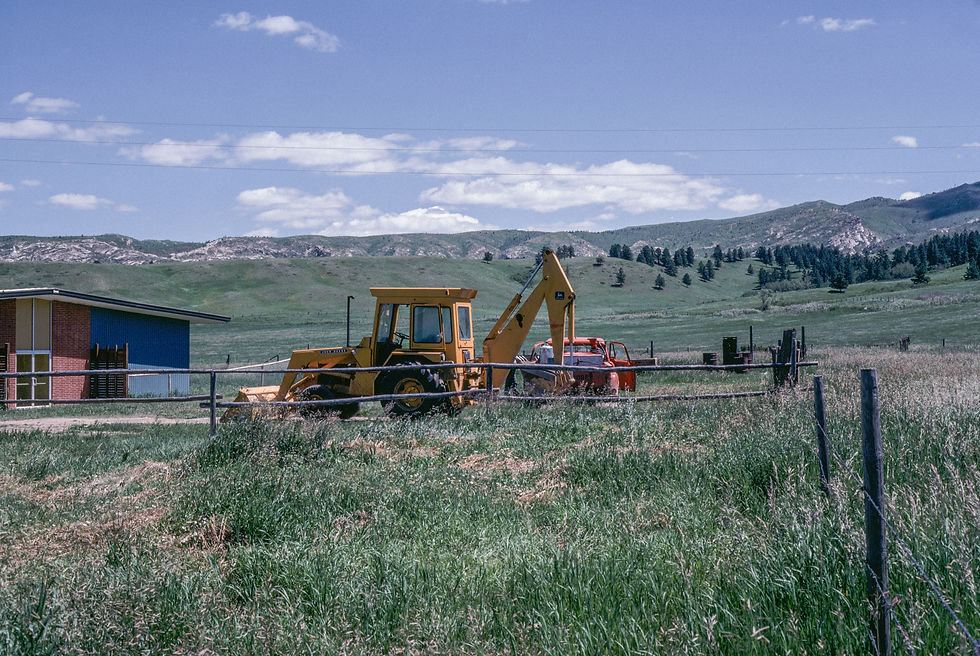
This is the backhoe at the mission. It was used for burials in the mission cemetery.
Davey said that Snake Butte had a rock that was the hardest rock around.
You ought to go out there and pick up a piece. When it’s polished, it’s really beautiful. They’ve used this rock to build a lot of dams. Fort Peck dam was built with this rock. (I asked him if the tribe had a settlement on this rock.) Yeah, they’re working on a settlement now. Jack Plumage brought up a good point about these settlements, and I agree with him. Instead of suing for money, we should have just asked for all the land back. The state owns thousands of acres on the reservation. They have one section in each township that they set aside in each township for school districts. We should have just asked for the land back instead of the money.
Ray once told me that in the old times, people smoked the black twist tobacco that they got from traders. They would pick and dry out the larb plants and would mix it with the tobacco. I believe that this is the larb plant Ray was talking about.


Comments