
August 1977 The Gros Ventre Language Workshop

8-1-77 rectory
I was talking to Father, and I told him that George Horse Capture was planning to change the date of the White Clay People’s language workshop. Father said that he would get in touch with him about it. They did pretty well for the workshop. Father showed me the form announcing the grant award. They received $3,890 from the Montana Department of the Humanities. George and Elmer Main (the education specialist, BIA) are organizing the workshop, but the grant had to be given to an institution, so they asked the mission to be the grantee. So, the grant was awarded to the mission in name.
8-10-77 mission
Vernie said that she was coming up to the mission on Saturday and Sunday. I’m going to speak Gros Ventre up there and teach some Gros Ventre. The workshop on Saturday and Sunday is with Elmer Main, George Horse Capture and a linguist, Taylor. She said she’d see us up there. They want me to be one of the teachers and to come and talk Gros Ventre.
8-12-77 mission
There will be a Gros Ventre Workshop concerning the Gros Ventre language and culture at the mission on Saturday and Sunday. It’s being announced as the White Clay People’s Workshop. It was announced on the radio and tv, and in the Camp Crier. The public was invited. The co-directors of the workshop are George Horse Capture and Elmer Main. Alan Taylor, a linguist from the University of Colorado will be there. He has done extensive research with Lakota and has written a textbook for learning the Lakota language. He has also done research with the Gros Ventre, Arapaho and other Algonquian languages. Joyce Horvath, a linguist from Great Falls will also be there. She, along with George, have done work to prepare a Gros Ventre dictionary using Father Sifton’s dictionary and work as the basis. The dictionary is at Gonzaga University, and another copy is at Catholic University of America (where Cooper and Flannery were professors). This dictionary was a major part of the workshop, asking the Gros Ventre speakers to check the pronunciation and accuracy of the translation. The workshop is funded by the Montana Humanities and Endowment of the Arts. An evaluation from Northern Montana College in Havre (Department of English and Indian Literature) will be there as an evaluator of the program.
Father said that invitations were sent to speakers of the Gros Ventre language, Paul Stiffarm, John Stiffarm, Jim and Beatrice, Andrew Lamebull, Theresa Walker, Vernie Perry, Matilda Cuts the Rope, Luke Shortman, Butcher Whitecow, George Birdtail, Al Buckman and Katie Longhorse.
8-13-14-77 Mission and Senior Citizens Center
The meeting started around 11:00. People were visiting and I had the opportunity to speak with Joyce Horvath, George Horse Capture, Allen Taylor and William Thackery.
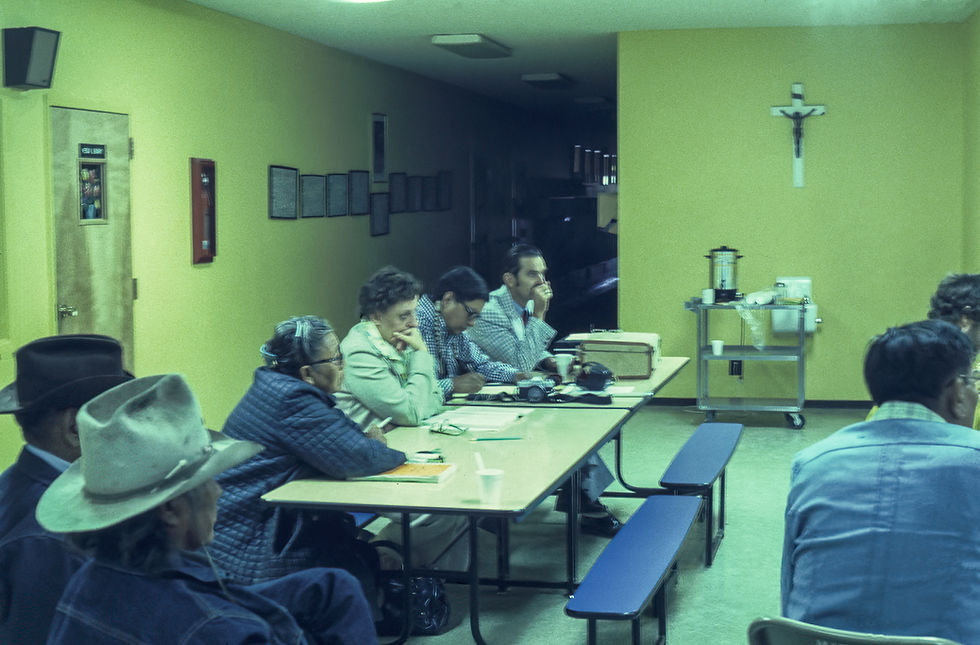
Elmer gave an opening address and an introduction. George also recorded the meeting, and Pat videotaped the workshop with Urban Rural equipment. The older people and guests sat in a semicircle facing the front of the room.
Elmer: Invited older people to record the history of the Gros Ventre. The Gros Ventre language is difficult. Must have grown up with it to be able to speak it. Difficult for late teens or older people to learn it. He grew up speaking it. In the first grade he spoke little English. Lived with his grandparents. He said that there were two kinds of Gros Ventre language, the old Gros Ventre and the more recent Gros Ventre. Most people speak the more recent Gros Ventre. It is dying out and they are trying to salvage the Gros Ventre language and culture. Preservation research workshop. Here to speak the language. Those who speak, speak out. Form small groups to talk about old famous chiefs, old timers. Discuss various aspects of the Gros Ventre economy, naming of things, animals. Bring out as many words so we can transmit it to younger people in a dictionary.
We broke for lunch at the senior citizens center.
The people attending the workshop on Saturday were Allen Taylor, Joyce Horvath, William Thackery (Northern Montana College, Department of English), Elmer Main, Education Specialist, BIA, George Horse Capture, College of Great Falls, Pat Bear, Ray Gone, Vernie Perry, Andrew Lamebull, Ruth Ironman, Katie Longhorse, Moses Nez Perce, George Birdtail, Quentin and Lilly Fox, Theresa Walker, Al Buckman (from Butte), Esther Doney. Invited but absent: Paul and John Stiffarm, Luke Shortman, Beatrice and Jim and Butcher Whitecow.
After lunch we returned to the mission for the workshop. George started the workshop:
He talked about Father Sifton’s work in the early 1900s. Joyce Horvath created a pronunciation guide. Expressed the importance of the language. It is not too late to stop the loss. This is valuable work and to also preserve the culture.
Father Shoenberg at Gonzaga has a copy of the dictionary. There are three thousand entries, but it is not a final product. To have the culture, must have the language.
Allen Taylor was here in 1964 and interviewed Fred Gone and Horse Capture (George’s mother’s father – his grandfather), from the University of Colorado. He was in Hays in 1961 and lived with Fred Gone for one week. He interviewed about life and the language as a student at the University of California. He compared the language to the Arapaho. He came back in 1964. He wants to see the language survive.
In January 1964, study of Algonquian linguistics. Recorded new material. Fred Gone died shortly after. The language is uniquely yours. Defines you as a group. What makes you Gros Ventre.
History of Gros Ventre language. In the Algonquian language family. The original home of the Algonquian peoples was the upper great lakes about 5,000 years ago.
I had to leave the workshop because I had to go to John and Joan’s wedding. Joyce told me that after Allen’s lecture, they started to tape people saying different phrases. Elmer walked around asking, how do you say …. And different people answered. People enjoyed themselves and laughed a lot. The workshop ended at 4:00. Allen stayed at the rectory and Joyce was invited to stay at Pat Bear’s house.
The language workshop was in many ways also a cultural workshop in that several topics were covered concerning culture change and the traditional Gros Ventre culture. Also, language and culture were tied together in many of the discussions.
I spoke to William Thackery after the workshop. He was the evaluator for the grant institution. He teaches in the Department of English and specializes in American Indian literature. He said that the project was well worth the money and would give it a good report. He said that we should keep in touch and he asked me if I would give a guest lecture to his classes at Northern Montana College about my research. I told him that I would be happy to and would contact him.
The co-directors of the workshop were Elmer Main and George Horse Capture. George is an American Indian cultural specialist at the College of Great Falls. Both are Gros Ventre. They served as monitors at the workshop and participated in the language research. Elmer did more talking about Gros Ventre culture and helped more with the language. Elmer lived for a longer period of time on the reservation and has a fuller understanding of the culture than does George, who lived for most of his life in California and received his BA from Berkley. In addition, Elmer knows the language and George does not.
The people at the workshop were paid. They received $100 for their participation. The older people enjoyed the workshop and especially enjoyed speaking Gros Ventre to each other and joking with each other.
Vernie turned to Andrew and said, wa-hey, the Gros Ventre word of greeting word by men, and Andrew answered with the woman’s word for a greeting – they use a different word regardless of whether they are addressing a man or woman. Everyone thought that was funny and laughed at Vernie and Andrew’s joke.
George asked Pat to transcribe the tape recordings for him.
Allen said that Father Sifton’s dictionary was biased towards his own interests and that some of the words couldn’t have been accurate in their translation. He has words translated from English to Gros Ventre meaning, angel, apostles. There weren’t equivalent words in Gros Ventre for these church-related, religious words. (If a single word requires a phrase to translate a word or idea it often reflects that it is not an aboriginal idea … the economy of words). Father Sifton has some words like this in his dictionary. Allen related another example from his Blackfeet language research. I asked them what the Blackfeet translation was for ‘running for council.’ The word they used for running was like running in a race. They didn’t have the word run like voting in an election. I asked the Gros Ventre the same question, how do you translate, running for the tribal council. No one knew the answer to that. They didn’t know the Gros Ventre translation for this phrase. I think that one of the main reasons for this was that the tribal council business was always conducted in English. The tribal council was established in the 1930s with the Indian Reorganization Act and the council was always with both the Gros Ventre and the Assiniboine so all of the business was conducted in English. Most people didn’t speak the other language. Assiniboine belongs to the Siouxan language family. Since political business was never conducted in a native language, words associated with modern or post IRA politics were never developed in the native language.
Allen Taylor is a linguist in the Department of Linguistics at the University of Colorado. He has done research with the native American languages. He did his dissertation research with the Blackfeet, another Algonquian language. He has since studied the Lakota, writing a language text for learning and teaching Lakota and has studied several Algonquian languages, including Gros Ventre and Arapaho.
He stayed at the rectory on Saturday night, so we had the opportunity to talk. Allen said that it would be very difficult for the Gros Ventre to learn and revive their language for several reasons. One of the reasons was that there was an old and a new Gros Ventre. Gros Ventre had changed and a lot of the words had changed in their pronunciation; there was an old and new depending on how the words were pronounced. Some present Gros Ventre pronounced words the old way and some pronounced them the new way, so this caused some confusion. Another factor that makes the Gros Ventre language so difficult is that in Gros Ventre there is a male and a female speech. There are differences between words depending on whether a man or a woman is speaking. The example I gave previously about a greeting. This makes the language more difficult to learn. But it can be done.
He said that he came to Hays for about a week in 1961. He was asked to do some work with the Gros Ventre language. He lived with Fred Gone for about a week when Fred lived in a log house. It had since burned down. Allen transcribed many Gros Ventre words and had the original notebook with him. Allen said that there have been so many changes in Hays since 1961, from then until now. It’s not just the new homes, the people look well dressed and they don’t look hungry. That’s the big difference from 1961. They sure do look good. They do have better homes and electricity and things like that, and those improvements have been made since 1961. There’s been a lot of acculturation, too, since 1961. There is plumbing now too.
The workshop on Sunday started at around 10:00. I was sitting with Dave Miller. He told me about Katherine Weist, Chairman of the Department of Anthropology at the University of Montana in Missoula. She was a graduate of Miami University and Ohio State. George invited us to Great Falls and invited us to dinner at his house sometime.
Attendees on Sunday: Elmer Main, George Horse Capture, Joyce Horvath, Allen Taylor, Ray, Vernie, Rosey Connors, Al Buckman, Matilda, Katie Longhorse, Theresa Walker, Andrew Lamebull, Quentin and Lilly, Butcher Joe Whitecow, George Birdtail, Sr. George Birdtail Jr, Esther Doney, Moses Nez Perce, Frank, and Pat.
All of the older women sat in chairs on one side of the room. Esther sat with her mother, Matilda, to help her hear what was being said. When Elmer would ask for a translation of a word, all of these older women would confer and when they all agreed, one of them would give an answer.
At the workshop I was sitting next to Ray. He bought a copy of the Gros Ventre dictionary. It was originally put together by Father Sifton during his stay at St. Paul’s Mission. This original Gros Ventre to English dictionary is at Gonzaga University and another copy is in Dr. Flannery’s possession at Catholic University of America. George Horse Capture and Joyce Horvath worked on this original copy of Father Sifton’s as a basis. George Horse Capture had about 75 copies of the dictionary published and he brought a whole box to the workshop. He was selling them for $9 each. Almost everyone there got a copy. He also advertised them in the Camp Crier a few weeks before the workshop. Ray looked at it and said, this looks like Chinese to me. He was talking about the phonetic alphabet. Ray knew some of the words, but he had a hard time determining the sounds represented by the phonetic transcriptions. The old people were talking Gros Ventre to each other and were laughing.
Allen Taylor Presentation – Language teaching efforts
1. Why you want to revive A’aniiih. Revival for children. Symbol of identity.
2. Use tribal language as much as you can in daily life.
3. Encourage everyone to try to speak. Don’t discourage. Correct mistakes but don’t criticize.
4. Tribal language is meant to bring people together. It is not political.
5. Teach language in schools. Formal. Converse in school. But schools are not enough. It must be active in the community.
6. Look for professional help in the schools. Language teachers. Involve outsiders. Use speakers as models and teachers. The teachers must know the language. Should teach language and not other things. Must have results, use full sentences.
7. Writing language – spelling, professional linguistics.
8. Recordings, use as much as possible for learning resources. Record all kinds of speech, not just public speech.
Joyce Horvath
Teaching children the Gros Ventre language. Encourage to speak. Begin with words, Indian names, nouns, preschool – simple expressions. Basic patterns. Understanding a language vs. producing a language. Understanding comes first, then encourage production. Tolerate mistakes and variation.
Learning and age. Words for things in daily life, nouns, labeling. Use Gros Ventre words for things that are uniquely Indian. Language and culture and tied together. Start early. Preschool and in homes. Put in schools with language teachers and have regular teacher stay in the classroom. She will learn and encourage language.
Age 7-10: stories, families, community – words, phrases, sentences.
Age 10-14: cultural process and writing.
Age 14+: philosophy, rules of grammar.
Elmer: Gros Ventre language classes at ONAP. Sponsor classes. Why do you want Gros Ventre language class.
Quentin: Part of our lost heritage. An important symbol.
Theresa: Hardly anyone speaks. Even my own children.
Elmer: How do you think – in English or Gros Ventre?
Moses: Hard either way.
Elmer: How do you dream or think … in Gros Ventre?
Allen: Language and thought.
Elmer: Listening to the old timers. Gear thoughts to English with people who only speak English.
Vernie: Thought more in Indian ways.
Elmer: Difference under age 7, thinking in English. Many of us think in both ways. For young people, difficult to convert thought to Gros Ventre. Offer formal classes, resources, people.
Ray: Not much formal education, keep up on culture. When people lose language, they lose 90% of their culture and then lose integrity. Our language was knocked out of us. Language and everything else.
Elmer: Compromise. Organize to bring it about. Do not be selfish. Dictionary is a good place to start. Phonetic spelling. From this, learn everyday words. Then learn phrases, sentences. Coordinate thoughts and ideas, go along with language.
Ray: Teach parents first. Learn first and then teach children at home. Also teach in school.
Elmer: Teach morals, religion, right from wrong, all at home. Family structure. In my family, I’m the only one who speaks it. Broader knowledge of our own people. Growing up confined to the reservation. Harlem twice a year. Havre once. During WWII had my eyes opened. Different for children today. Gather fragments, salvage culture and language. Thank old people.
Allen: Gros Ventre Language Association. Old people and adults, strong motivation. Make it a top priority.
Elmer: Gros Ventre committee in Hays. Frank heading it up.
Al Buckman: Start language with young people, couples.
Elmer: College, a lot take up social work, come back here and help people out of poverty, overstressed. Need other fields, linguistics, medicine.
Al Buckman: All different fields and come back and teach our people.
Allen: Minority peoples, awareness and interest in cultures. Indian clubs with older people, making them speak the language, only talk in Gros Ventre.
Elmer: Teaching language and culture. Young girls, beading, make fry break, berry soup, sculptor and painting. Doctoring at home with remedies, appropriate to do again.
Allen: Scouts and 4H.
Ray: The formal school system – wrong concept of culture. Culture not just crafts. It is everything – religion, economy. Formal school systems, have to be in schools.
Elmer: Indian studies in higher education. Help students with academic problems. Main purpose. University of Montana – 200 Indians from all over the northwest. Meet – exchange views, customs. Main role – get students through college. Graduates from this college now work for the tribe and BIA. Not all of them have degrees.
Elmer to Father: What is being done here at the mission?
Father: Nothing specific, not that much. George Horse Capture pictures brought in. People from the community talk to the kids. Kids and adults might enjoy the prayer service translated into Gros Ventre, such as the Lord’s Prayer. Way of bringing ourselves together.
Elmer: Teaching Indianness in high school. Sister Giswalda took the constitution, went through tribal government. Brought in Johnny McMeel, Rufus Warrior.
Father: Put designs in the church.
Joyce: Language in schools. Parents don’t want to take time out from school day.
Elmer: Teachers must be able to do this. Not easy. Constitution needs to be rewritten. More restricting than before. Cumbersome, hard to understand with legal jargon. We were captives under the BIA. Strict. Agents were dictators. Tribal council hands tied. Not much could do. Before the Indian agents, we had Army Officers. Little land to get by. Besides farming, what did you do?
Theresa: Gardens, berries, wild game.
Elmer: Implements given.
Theresa: Walking plows, wagons, harnesses.
Elmer: Restrictions on Indian.
Katie Longhorse: Needed permission to leave.
Theresa: Ten days leave – permission pass.
Quentin: To visit other reservations.
Elmer: Many restrictions. Only plow so much. Lease money.
Katie: Went into their pockets.
Elmer: Gave us cows and horses, government brand, ID, Indian Department or D govt; permit to sell livestock. Restrictions over old people’s heads. Today restrictions: sale and exchange of land, borrow from them and how much, BIA liberal in past few years. Tribal council used to be a rubber stamp. Before – dictatorship.
Quentin: Not restricted from being drafted into the army.
After the workshop about language, Elmer asked questions about the Gros Ventre culture.
The meeting ended at 3:30 on Sunday.
At the end of the meeting, Elmer said to me that he had a lot of information from and about his father, Tom Main. I’d like to put it all together, but I just haven’t had the time.
George said that the old people sure had a good time. They laughed with each other and enjoyed talking Gros Ventre to each other. Joyce said that the importance of the workshop was in salvaging the Gros Ventre language. But there’s not much we can do in two days. George’s original plan was to go through the whole dictionary in those two days, but he didn’t realize how much work and time that would take. He said, I think what is important now is that we establish an awareness of the Gros Ventre language and the importance of the language so people realize how important it is that we bring it back, as much as we can. This awareness is as important as the salvaging is right now and especially with the time we had this weekend.
Susie and I were talking to Moses Nez Perce during the dinner at the wedding reception. He had been at the Gros Ventre language workshop. Susie left at 1:30 to help prepare the meal for the reception and I left at 2:30 to be at the ceremony to take photographs.
Moses said that Elmer asked about words and he asked easy words, like parts of the body. These are words that are used all the time and people agreed on all of these words. He said it was sure good to hear our language. It had been a long time since I had heard it. Gros Ventre was all my grandparents spoke. My parents used half and half, half Gros Ventre and half English. I can understand it, but I can’t speak it. I know a little. The Arapaho and Gros Ventre can understand each other, but to the Gros Ventre, the Arapaho talk broken, but you can understand what they’re saying. It’s like Crow and Gros Ventre (Hidatsa), they can understand each other, too. But Crow is a lot easier to learn than Gros Ventre.
The hardest times were for my parent’s generation. That’s when there was the most change. When they went away to school, they had the Gros Ventre language beat out of them. They couldn’t talk Gros Ventre, even on the playground. If they used Gros Ventre in the classroom, they would be punished. It was real tough on those people, my parents and their generation.
Moses said that they’ll never bring back the Gros Ventre language. There aren’t enough people who speak it and they’re not passing it on. If they bring it back, it will be a miracle. But I don’t think they really will. It is gone. There aren’t enough people to practice. Like Beatrice and Jim. They talk Gros Ventre to each other all the time. And they talk Gros Ventre real good.
We did easy words on Saturday. Sunday we will do harder words. Joe Butcher Whitecow and Luke Shortman know all the hard words. They will be there on Sunday. They really know the language.
8-13-77 mission
Allen said that he and one of the workshop participants looked in on John and Joan’s wedding reception and Allen commented that it looked just like a white wedding, their dress and the reception. The person told him that it was a “breed” wedding. I asked if he was serious and Allen answered that he was very serious.
Allen said he hadn’t realized that there was a problem here with prejudice and degree blood. I told him that there was a big problem. It’s especially bad in the community with the landless Indians in Hays, the French Cree. Allen said that the French Cree did seem very acculturated, the whole area seemed to be very acculturated.
I’ve run into a problem with this degree blood thing as it relates to language on other reservations. And I’m going to address this problem tomorrow at the workshop during my talk. A lot of times the native language becomes the property of the full bloods, and they won’t share it. The full bloods try to keep an exclusive hold on the native language. They won’t teach the other people the language, and it just becomes a different factor that divides the community. The language should be something that brings the community together. It shouldn’t just be kept among the full bloods.
The great irony of this situation is that John, the groom at the wedding, is Gros Ventre and his grandmother was a significant participant in the workshop and an excellent native speaker. This is the breed that was being referred to by the participant. John was marrying a white woman who was a teacher at the Hays Lodge Pole High School.
I have written extensively about the degree blood issue, so I will spare you the diatribe. Suffice it to say that I understand why tribes use degree blood as a membership determinant. There really isn’t another rational or sound way to do this. But the whole issue about breeds makes my head want to explode. This notion of a breed, a mixed blood, was the cause of so much feuding, divisiveness and even violence on the reservation. I’m really not sure how anyone on the reservation could be absolutely certain that they were a full blood Gros Ventre. When the tribal rolls were originally established, I have no idea how they would have done this besides taking the word of the person who was reporting the degree blood of their parents. How many generations could they have possibly known. These people were intermarrying with other tribes and with whites.
I sure hope the prejudices surrounding degree blood and the derogatory use of the term, breed, have evaporated.
8-14-77 mission
After the workshop I was talking to Alan Taylor about his work with Fred Gone on the Gros Ventre language. He said that a lot of these people don’t trust whites and they are very suspicious about people doing research. They think that you’re going to write a book and that you’ll make a lot of money and they won’t get anything. So they’re suspicious and won’t tell you much.
8-14-77 mission
Before lunch at the workshop I was talking to Elmer about what the mission was like during his time there.
The mission used to be real strict, especially the brothers. Some of the priests were really strict, too. Father Fussi was one of the toughest. They used different punishments on the kids. We had to learn the catechism by heart, and if you couldn’t answer a question, they punished you. You’d have to kneel in the aisle, or they’d make you stand and hold two sticks out with your arms (Elmer demonstrated). If you started dropping your arms, and they did get heavy, they’d really crack you until you lifted your arms back again. The mission was strict and the punishments were tough.
And those boarding school days were the toughest. I went to the boarding school, and I went to the day school when Sister Giswalda came here and they had the high school. Brother Fox was here later, and they were changing the treatment by then. I went to the boarding school when the Ursulines were here. They were strict and they were tougher. The brothers were tough too. I went to the high school at the mission when the Franciscans came here.
The people here became Catholic because they didn’t have an alternative. They had to convert; there was no alternative. We had to take Christianity. We had our own religion, but they beat it out of us. They beat it out of us literally. We had no choice but to be Christians. We had to go to school. They forced us to go to school. We were coerced to accept Christianity. We had to memorize the Catechism, every bit of it, and if we didn’t learn it, we were beaten. Father Fusi was just a short man and he was a lefty. He used to give you a left back hand across the face. (Elmer imitated). I remember that real well. They had another punishment, too. If you didn’t memorize the Catechism and things like that, they’d use a rubber hose, and beat you across the butt or across your hands.
There were pets, that’s what we called them, at the mission, too. They were the favorites. They used to get special treatment and they got special food. They would tell on other kids, like if they used the Indian language, they would tell on the kids talking Indian. It was tough on us at the boarding school for other reasons, too. When we went to the mission boarding school at first, there were mostly Crees in the school. You can ask anyone, there were more Crees in the school than Gros Ventre or Assiniboine. This was in the early boarding school, and the Crees made it tough on us.
What makes me feel better about all these things that happened is where I’ve made it today, and about my education. I was the first one on the reservation to get a college degree. I got my degree from Gonzaga University. I went to school for a while, but then I had to quit because I hardly had any money. I got some help to go to school but all the people around me had some kind of spending money, and I had nothing. So, I quit school, and didn’t go back until after the war. I enlisted in the army during WWII. Most of the guys from here (reservation) served in the same division, the 163rd infantry. That’s one of the reasons the Gros Ventre culture changed so much and why the language was lost. When the men here served during WWII in the army, most everyone went overseas. They saw so much more of the world, and they started to change their ideas about things. It really opened their eyes to so much more. They saw much more of the world than they had ever seen before. The same thing happened when people left the reservation to find jobs. A lot of men from here went to Seattle to work in the mines. Not everyone stayed in these jobs, but most of them stayed off the reservation and found other work in the cities. Then there was inflation and people had to find work, and had to work real hard. People were just too busy working to think about Gros Ventre culture and language being lost.
8-14-77 Mission
During lunch at the workshop, Susie and I had lunch with Ray and Dave Miller. Dave said that he was at a meeting over the weekend in Billings about tribal constitutions that was sponsored by the Northern Cheyenne. He said that D’Arcy McNickle gave a talk about the IRA. Jack Plumage, the Gros Ventre tribal chairman, gave a speech about resources. He said that Ft. Belknap’s greatest resource was its people. Dave said that the Gros Ventre revised their constitution, and it was supposed to have been voted on in November of this year, but the constitutional convention was having problems because of the BIA and Secretary of the Interior weren’t accepting the revised constitution. It’s supposed to go before the people in November in the general elections. Ft. Belknap was well represented at the meeting. They had about 12 people there.
8-14-77 mission
After the workshop lunch, I rode back to the mission with Dave Miller and Vernie. Vernie said that it was going to be a tough winter this year. You know that because we got a lot of berries this year. Everything was early this year too. The june berries came ripe in July instead of the end of July and the choke cherries were ready at the beginning of August instead of later in August. Everything was early. The choke cherries are good for syrup when they’re red and they’re good for soup when they are black. You know, this is how we used to tell when it was somebody’s birthday. They said that I was born when the juneberries come ripe. I was born on July 2, 1899. Or they would say a person was born when the first freeze comes or when the first snow comes. That’s how they could tell when someone was born and when their birthday was.
8-15-77 Gordon and Edith’s
Gordon was talking about the language workshop and he said, it was sure funny the way the world is. First they take our language away from us and then they want us to bring it back. At that workshop they talked about bringing back the Gros Ventre language. It’s going to be tough to bring back. You have to teach it and learn it when you’re young. They’ll have to get teachers to teach the Gros Ventre language too, and I suppose the teacher will need ten years of college degrees (he was sarcastic). I don’t know if any Indian would be the teacher, but an Indian teacher should do it.
I can remember when that man (Alan Taylor) worked with Fred Gone (Edith’s father). He took down our language. He has our language in a book, and he took it with him. I never did see that book that he wrote our language in. He took it with him. They used a cigarette paper when Fred was teaching him Gros Ventre. I watched it. He would hold the paper in front of his mouth, and would watch to see how the paper moved to see if he was saying the words the right way.





Comments