
August 1977 The Second Year

In August, Susie and I would have lived in Hays and worked at the mission for a year. With this milestone, I am going to refocus my blogs from the ordinary and day to day life in Hays and on Ft. Belknap to the more out of the ordinary. My blogs will spend more time on unique events, ceremonies, and rituals. I am also going to focus my writing more on the conversations I had on a regular basis with people. During the first year, we became very close to people in the community. In large part, this happened because of the work we were doing in Hays. Susie and I were teaching at the grade school. Susie was running the breakfast program. I was driving the bus and helping Jim clean the school every day. I was taking care of the chickens and the mission garden, including Bill’s greenhouse. My teaching at Urban Rural had ended but I was still working on the GED program. And we had so many other informal responsibilities at the mission from phone duty to bingo to recreation nights. Susie was also running the arts and crafts program in the mission basement for adults in the community. As everyone understood by this time that I was the resident cultural anthropologist, these conversations were, to a large extent, interviews. Susie and I asked a lot of questions, and more often than not, people most graciously offered answers. We had some wonderful relationships with people, mostly from Hays, but also from Lodge Pole and the Agency.
Our involvement in so much activity put us in places where we were meeting and getting to know so many different people. Regardless of people’s connections to the church, it remained the center of so much of the social and religious life in Hays. Regardless of just how pissed off a person might be at the church for a multitude of reasons, they were showing up at St. Paul’s regularly, to bring their child to school, to use the phone, to attend a meeting of some kind in the all-purpose room or gym, to attend Susie’s arts and crafts program, to attend a pow wow. We were working at the mission during these social and religious events, and for many of them, we were doing something more important than working. We did our best to show up to help celebrate with families who came for a baptism, first communion or wedding, or to offer our care and support at a wake and funeral. Susie never missed an opportunity to roll up her sleeves to help the women in the kitchen prepare and serve at the feeds held on these occasions.
The thought occurred to me more than once that I could have done two years of my research by merely sitting in the living room of the rectory next to the telephone. There was constant visiting going on either while people were waiting to use the phone or after their phone conversation was completed. The only people I would have missed would have been the very few people who had a telephone in their home.
Susie and I came from a world where there was no shortage of distractions. In addition to the time we spent with family and friends, there was so much available to us in the way of entertainment. We came from a big city where there were hundreds of restaurants, movie theaters, many different museums, sporting events, and so many other options for the ways people spend their time when they aren’t working … or going to school. Besides the mission and the trading post, there was nothing in Hays that looked anything like the place from which we came. In the mid-1970s, there was one store in Hays and nothing else. The only buildings in Hays that weren’t homes were at the mission, the senior citizen’s center, the trading post, the Hays Clinic, the schools, Herbie’s garage, the Urban Rural trailers and Bruce and Ida’s store.
The vast majority of our social activity in Hays was visiting with people. My field notes include the place where our conversations took place. I would roughly estimate that about half of those occurred in our trailer! We spent so much time in people’s homes, and they spent so much time in ours. For most of our time together, we did what people do in these conversations … we shared our lives. People figured out pretty quickly that Susie and I were totally open and honest people. We were open to developing whatever relationship people wanted to have with us. We were accepting and made no judgements about anyone. We were genuine with people … thus, you liked us or you didn’t. If you didn’t, you didn’t come to visit us at our trailer. This is what we did in Hays and consequently, we became very close with people, very quickly. During my time in Hays I was probably smoking around three packs of cigarettes a day and having about 20 cups of coffee, because that’s what we did when we were visiting. And when we weren’t working … we were visiting.
I recently developed symptoms in my lungs, and my doctor ordered a scan done. It turns out that there are some nodules in my lungs from a fungal infection. I guess this is fairly common in the Ohio Valley. I have to get scans done every year to rule out that any of these residual nodules becomes a cancerous tumor. It would be some kind of irony should I get lung cancer from a fungal infection after smoking all those cigarettes. I did quit smoking when I was forty … but I smoked a lifetime’s worth in Hays. Allen’s store shelves were often pretty empty, but the cigarette counter was always well stocked with Winstons and Marlboros.
Most of our friends’ lives were pretty challenging. While Hays got some paved roads, electricity and indoor plumbing before we arrived; life remained incredibly difficult for people. We genuinely cared about our friends, and we were grateful that we could offer emotional support to people who really needed it. Almost none of those conversations appear in my blogs. We were pleased to be able to listen to people who really needed to talk about their problems. Many of the things people shared with us were about marital and relationship problems or difficulties they were having with their children. There is nothing unique to problems of this nature the world over. In Hays, these problems were magnified and intensified by poverty, alcohol and the general despair that permeated so much of life resulting from cultural trauma. I’m not going to characterize this situation as living between two cultures. I don’t think that accurately captures the nature of the problem, and it definitely simplifies it. The trauma was more about having a beautiful way of life and language dramatically and rapidly ripped out of them and not only failing to offer a satisfying replacement but offering that new Americanized way of life in about as half assed a fashion as one could image. Beliefs, values … a way of life becomes mayhem under those circumstances.
I have done my best to honor our love for people in the community by keeping those most personal conversations out of my writing.
The strength of those relationships is reflected in the fact that I have stayed connected with our friends for a lifetime. During the 1970s, the reservation community was overrepresented by the young and the old. There were so few employment opportunities on the reservation that so many people of working age left to find work. Some of them came back, many came back for visits and many others only returned for a funeral of a loved one or not at all. Consequently, the majority of the people we loved are gone. I’ve written before that when I have come back to the reservation, I have visited as many of their graves as I could find to stand before them to say Kaddish. I have such fond memories of our time there … it was all about people. But I also hold so much sadness from all the loss we’ve experienced over the years. That’s just how it goes when your best friends are old. I am watching my mother go through this experience. She’s turned 100 years old this year. When you live that long, you experience a tremendous amount of loss from all of the family and friends who have died before you. It is very difficult and depressing.
I have remained friends with the children and the grandchildren of those we’ve lost. While I believe that Facebook is something akin to an open sewer, it has given me the opportunity to stay connected with people I care about. After losing Pauline in Montana in 2017, it remains an emotionally challenging place for me to return. It is painful for me to think that I might not be able to come back. The place holds so many incredible memories for me. And now those memories include a heaping pile of sadness.
I would like to address the topic of mayhem. I have written about mayhem in the community over the past year of our lives in Hays. There was no shortage of every variety of chaos that our friends experienced in the community. There was no shortage of mayhem that Susie and I experienced. As with the case of alcohol, I am going to limit my discussions of mayhem to only the most out of the ordinary occurrences of it. If you have been reading my blogs, you know that I have handled alcoholism in the same manner. I presented my discussions with Ray about the topic, and I promised him that in my dissertation, I would limit my treatment of alcohol. I believe that I honored his request. I have attempted to do so in these blogs, as well. There was a lot of it. It was endemic in the community, and it caused so much hardship. Period.
I would like to manage the mayhem in the same manner. It was endemic. It caused so much hardship. And everyone in the community experienced it in some form or fashion on a regular basis. Theft, vandalism, accidents, and fights occurred regularly. So much so that mayhem became a background noise in the community for the duration. Sad. Destructive. Demoralizing, Depressing. Frustrating. Maddening.
Before I move into this second year of life in Hays, I would like to briefly discuss feuds in the community. It was some really serious stuff, and particularly in a community of just around 600 people. The feuding went on regularly and it manifested in everything from people ignoring each other, to people rumoring about each other to some serious violence. The number of factions and the amount of feuding that was going on was magnified by the fact that it was going on in a small, isolated community of about 120 households.
There was feuding between people of different tribes – the A’aniiih, the Nakoda and the Metis. And feuding sometimes involved the degree blood issue. There were disputes between off-reservation and urban Indians vs those who lived on Ft. Belknap. The feuding went on between families, and once a family was involved, it encompassed all of the members of that family. And it involved individuals. During our two years in Hays, we didn’t observe any feuds being resolved. Father would try. The prayer groups would try. The Catholic Indian Congress that was held during the summer was focused on this community healing. There wasn’t a whole lot of healing going on. This feuding was emotionally and psychologically intense and draining. It caused so much division and social disintegration in this small community.
Susie and I weren’t involved in any of it. We remained impartial and totally neutral when the feuding was introduced into our lives. I’ve never been particularly confused about right and wrong, good and bad, immoral and moral, ethical and unethical. I had opinions and I definitely took sides in my heart and mind. And as Pauline would regularly admonish, I kept all my brilliant opinions to myself. We would hear the malicious rumors and we would remain silent. So long as they weren’t stealing our gas or shooting at us (both of which occurred to us at least once), we stayed out of all of this destructive feuding and mayhem.
Alcohol was often involved in precipitating events, and it was involved in ongoing retaliatory occurrences. And the violence that was involved sometimes caused killings. As the reservation often felt like the wild, wild west, there wasn’t too much in the way of consequences to discourage this kind of activity.
The mayhem never ceased and the disruptions to peace and tranquility in the community were considerable. There is no way I would be able to characterize this behavior as mayhem if I was writing an honest-to-goodness academic piece of work. I’m not. I’m grateful that I’m not. What I have been doing is likely way more candid than I would be allowed in an academic piece of work. But I do think that mayhem is the most effective way for me to characterize a variety of behaviors that were common in the community, from crashing cars all over the place, to shooting people’s cats, dogs and horses, to stealing just about anything that wasn’t nailed down (and some things that were nailed down), to physically fighting someone, to shooting someone. Unadulterated mayhem.
Poverty. Unemployment. Unstable family life. Alcoholism. Acculturation (having a language and culture ripped out of the people with no satisfying replacement, i.e., confusion about beliefs and values). There were many different causes of mayhem.
I am going to have to write about some of it, because there were occurrences that went way beyond the endemic background noise.
I can only hope (and I fervently hope) that there has been improvement and that people have found more healthy ways to resolve disputes in the community (or avoid them altogether).
Anthropologists characterize non-western and folk cultures as being highly integrated. All the institutions are an integrated web (i.e., economic, political, social, kinship) in the minds of the people of a society. Not only are these institutions highly integrated, they are also mutually supporting. The people who practiced traditional A’aniiih culture and spoke the language did not think of economic or political or social systems when considering their way of life. Their culture was an integrated whole.
Acculturation and primarily the adoption of English as the first language changed this important facet of the traditional culture. Language defines how we think about and categorize our way of life. In western culture, in American culture, our institutions are more compartmentalized. When we think of political institutions, we can define a class of behaviors that can be placed in that category. In the case of the contemporary A’aniiih, the Tribal Council and the Treaty Committee are engaged in political activity.
This compartmentalization has changed the way the A’aniiih think about their own way of life. A contributing factor encouraging this change in thought patterns is the relationship the tribe has with the federal government. There are so many different government programs and so many different agencies that the tribe relates to in their everyday life. This compartmentalization can be observed in the names of the different programs, offices and agencies on the reservation. Housing Authority, BIA office, Tribal Office, PHS-IHS hospital and clinic, Tribal police and court, detox, Manpower office, recreation center and department of recreation, ONAP building – planning, tribal programs. These are different programs and each can be categorized into different institutions, i.e., political or economic or social. Not only are these institutions not integrated, often there is little relation between the programs. This compartmentalization is further evidenced by the fact that most of these programs are not under the authority of the BIA, and they are not even aware of how these other programs operate. I was told on more than one occasion by BIA officials that if I wanted to understand all the programs on the reservation, the tribe would be the only source of this information.
Another category of institution for the A’aniiih is religion. It is the one institution that has nothing to do with the government (because the US Constitution says so). But religion is its own category, unrelated in most respects with the other categories and represented in various ways on the reservation, from the Catholic Mission to the Christian Missionary Alliance, to traditional ceremonies (the sweat lodge, the spirit lodge, the handgame, peyote meetings). Perhaps religion is the best example of the nature of change for the A’aniiih. Traditionally, religion was a part of all other aspects of their way of life. Today, it has become more something people practice in a building that is different from the political or economic buildings on the reservation.
The concept of time is related to the way culture change has impacted the A’aniiih. With acculturation, the A’aniiih conception of time has become more westernized. ‘Time is money’ is a very western concept and would have been entirely foreign and nonsensical to a traditional A’aniii. Time is money comes from the equation of time with work. Western society defines our day-to-day lives within the structure of time; times to wake up and go to sleep, times to eat meals, times to work, and times for recreation.
The traditional A’aniiih had a much different conception of time. It wasn’t by any means chaos or random, but it wasn’t dictated by a clock. A’aniiih life was a function of the seasons, of the ripening of berries and other plants, by the migration of the buffalo, by the weather and by the cycles of the sun and moon. Hides were prepared after the hunt and when clothing or tipi covers needed to be made. Choke cherries were picked when they were ripe. There was a seasonal cycle to religious rituals. And what we in western society would characterize as religious behavior was infused into every aspect of life. It wasn’t random by any means; life was dictated by choice, tradition and necessity.
Another important change for the A’aniiih was the conception of land. For the traditional A’aniiih, the tribe used the land communally. The clans and the tribe operated as a whole, and most activities were performed in the name of the tribe. Life was about the tribe and not the individual. Without getting into the whole history of acculturation and allotment, the A’aniiih conception of land changed dramatically. First, the notion that a person could own land was entirely foreign to the A’aniiih. The Great Spirit provided the land and resources for the people to use. No one owned it. For the contemporary A’aniiih, individuals own the land. The repercussions of allotment and individual land ownership have had a profound impact on contemporary values and the contemporary economic, social and political systems on the reservation. Individualism has not totally replaced tribalism as a primary value for the A’aniiih … but it has definitely eroded the significance of tribalism for these people. This difference between tribalism and individualism was a major issue for the chairman during an interview that Susie and I conducted with him in August 1977. I will present this interview with Jack Plumage in an upcoming August blog. Jack’s perspective on this issue characterizes the impact this critical change in values has had on the tribe politically and economically.
The A’aniiih way of life had changed so dramatically from the time of the traditional culture to what Susie and I observed in the 1970s. It is my great hope that anthropologists have contributed to at least keeping the traditional culture alive in people’s minds and memories, if not in practice. The works of Drs. Kroeber, Cooper and Flannery captured as much as was possible of that traditional A’aniiih culture. My work and what I am publishing in these blogs attempts to describe the way of life I observed and recorded about fifty years ago. It was beyond a transitional time. The culture had already changed so dramatically from the great grandparents’ and grandparents’ generation of the adults we lived with on the reservation. In addition to these observations, Susie and I focused on the process of change, and we made a point of interviewing the elders in the community about the traditional culture they remembered, and about how they experienced all this change in their own lives.
My great hope is that the A’aniiih, the Metis and Nakoda figure out a way to assimilate sufficiently into the modern American culture that they can succeed in every way possible as members of our society; while at the same time, holding on tenaciously to the beautiful traditions of your people. This is a subject on which I have a very intimate understanding. This is precisely what my people have done. I was raised in an orthodox Jewish home. My grandparents all fled from Eastern Europe during a time when Jews were being slaughtered for one reason, and one reason only … they were Jews. They came to America without knowing any English. They came without educations, because Russia did not allow Jews to attend their schools. And they came without any work skills or trades. In two generations, they experienced tremendous change. They learned English. They became highly educated. And they learned how to be successful in American society.
Many also went through this acculturation process without losing their traditional Jewish culture and identity. They were able to hang on to their Jewish way of life, even when their beliefs and behavior were different from, and sometimes, came into conflict with the dominant culture. These conflicts can manifest psychologically or emotionally, and they can also manifest in very concrete ways. It is the inevitable consequence of living as a minority in a culturally different dominant society. We have accommodated and adapted, but we have not abandoned our way of life … our beliefs, our traditions, our rituals, our values, our behavior.
It is absolutely the case that we didn’t have to deal with the same acculturative pressures that were faced by your people. You faced an onslaught of brutal forces from ranchers, miners and settlers, and from our military and our government and from the missionaries. The forces on my community were far more subtle. And we are white, which gave us the advantage of getting past first impressions, i.e., it took a few minutes before we were hated as opposed to attracting distain immediately. And some people could choose to pass, and they did.
Hate is a thing. Distrust and suspicion is a thing. Humanity has hated Jews for thousands of years. I can offer you a ton’s worth of history to explain antisemitism. I’m just going to boil it all down to a very simple phenomenon. Difference just rubs people the wrong way. All the western religions teach about loving the stranger. Why? Because it is the natural inclination for people to dislike, be suspicious of and to distrust people who are different. It would be really wonderful if it wasn’t this simple or that it wasn’t human nature. But it is, unfortunately, the state of affairs for humanity. There’s unequivocal evidence that this is the way humans have operated going back to the beginnings of human prehistory and history. It is a function of the way we learn our own way of life. I’m not going to get into the details of this. I’ve explained it numerous times before; I’m tired of thinking about it. Look up ethnocentrism or read my earlier blogs if you are interested in learning more.
The whole notion of accepting or, holy crap, celebrating, diversity didn’t happen until after humans started living in cities where groups of diverse people found themselves among those who practiced many different ways of life. For most of human prehistory and history, human groups just stayed away from each other. And that worked great so long as the resources where people lived could support that group. When resources became scarce, that’s where the trouble would start. Contact and competition for resources often ended badly for one or both groups.
Accepting and caring for the stranger is all over the Old Testament, and it was a central theme of the teachings of Jesus. I am less familiar with Islam, but I’m going to guess that they also picked up this diversity mantel and ran with it. It is a part of the major religions because the consequences of this hate, suspicion and distrust of the stranger is so destructive to all of humanity. And that includes ALL of humanity, both those who belong to the dominant society and those who are minorities. People who are filled with hate are just not healthy people. How happy and content can a person be with their own lives when they are filled with hate? It is fundamentally sad and pathetic. This hate is about all people who are different and does not just apply to minorities in a dominant society, i.e., the Hopi and Navajo hate each other and the Crow and Sioux hate each other. Or at least they did fifty years ago. Have they resolved their feelings in the past fifty years?
Not only haven’t we figured out the whole acceptance of the stranger, the dominant society has figured out a way to feel like minorities who have little political power are discriminating against them. I observed this most obscene phenomena during my research. While your people have been so monumentally shat upon by all manner of the dominant society, when I lived in Hays, the white people in the towns surrounding the reservations regularly expressed that they were being discriminated against. Surreal. I shared a similar experience when my children were in elementary school. During the month of December, their school district included a month of Christmas “learning” as a part of the graded curriculum. The subject matter ended with the Christmas concert just prior to “Christmas vacation.” Based on the US Constitution, public schools can teach about Christmas, but they are not allowed to celebrate the holiday. I did not want my Jewish children to be forced to celebrate a Christian holiday. The US Constitution is on my side. If you want to pass the straight face test on this, teach about Christmas in May. The school superintendent asked me to work with a group that redefined the way the school district managed the Christian holidays. I became the guy who killed Christmas in the schools and discriminated against Christians. Looney toons. I wasn’t asking people to stop going to church or to not celebrate the holiday in their homes or the shopping mall or every other friggen place in the universe that starts decorating for Christmas and playing Christmas music (much of which is written by Jews) starting ten minutes after Halloween. You couldn’t kill Christmas with the most advanced nuclear weapons, let alone some Jewish guy.
Diversity is a tough one for all societies. In America we currently have the most manifestly racist president, perhaps of all time. And that’s saying a lot because most of our presidents before the emancipation proclamation were slave holders. One of his favorite presidents is Andrew Jackson. He has his picture up in the oval office. My A’aniiih, Nakoda and Metis friends will appreciate the viciousness of that proposition. I’m not going to get into our current state of affairs or this blog will quickly expand into a book. I am loaded to the gills with opinions about what we are experiencing today.
Suffice it to say, we take one step forward and three steps back. Cha cha cha.
For our own well-being as individuals and for the health and welfare of our communities, it is best not to depend on the dominant society to fix this age-old problem of hate. We have to start with fixing it for ourselves.
I want to share the magical powers that Jewish individuals, families and communities have developed and employed for centuries to live healthy and happy lives as minorities in societies that hate and hated our guts. And, again, you can come up with a whole myriad of reasons to explain this hate, but the most effective and simple way to explain it is that we were different. In the face of all of this hate, we loved our differences and we were proud of those differences.
And this is what I hope for all of you! The magical powers start with not internalizing the hate from others. This isn’t your issue in a psychological sense. It is theirs. Allow them to wallow in their own toxicity. Take solace in knowing that the people who are doing all of this hating are unhealthy and unhappy people. I feel sorry for their children. Being a colossal jackass is an inter-generational issue, like pattern baldness.
I know who I am. I know what I am. I am proud of who I am. That understanding and those feelings allow me to put up my force fields when it comes to the beliefs and feelings of others. I don’t own what they ascribe to me. It takes a solid self-concept and an acceptance of the beauty of one’s own way of life. I was given those attributes from my parents, from my family and from my community in the way I was socialized. I hope I have given that to my children and to my grandchildren. Jew hate isn’t going to stop me from being a practicing Jew and it sure isn’t going to stop me from being proud of being a Jew, my heritage, my family, my traditions, my way of life. I’m an American and I am a Jew.
And it is imperative that you give all of this to your children and grandchildren. They need to have that self-esteem and that pride in who they are. The force fields are possible when it starts with a person who likes and loves themselves. They need to have a good education, and they need to have good role models. When I lived in Hays, there were so many A’aniiih who were well educated and were making exceptional contributions to their tribe and to society. Children need to internalize this understanding of their way of life and be proud of who they are.
Parental education attainment is among the most reliable predictors of children’s educational achievement. My father was the first person in his family who received a college degree. He did so after the war on the GI bill. My brother and I both received PhDs and my sister got her master’s degree. That’s how that works.
Role models are critical. While my children were growing up, I made a point of teaching them about how Jewish people have made important contributions in our society. And these models came from every walk of life from education to the arts to medicine to sports. You have these people in your own societies. James Welch should be required reading for every A’aniiih child. Fools Crow is one of my all-time favorite books.
Jews and Native Americans each make up something around 2% of the US population. That 2% for Native Americans includes all of the tribes. There is an enormous amount of diversity represented in that 2% of Jews. That diversity spans religious, social, economic and political divisions. Jews today live in more than 100 countries – different ethnicities, different languages and cultures. We rarely agree as a group about anything. But solidarity occurs when there is a threat from the outside. When Ferdinand and Isabella were either expelling or killing every Jew in Spain, no one was asking whether they were Jews who kept the Sabbath or not. Jewish parents. Dead. Hitler and Stalin weren’t asking anyone if they knew anything about the Torah. Jewish blood. Dead.
Native Americans have a bit more complex situation. Your diversity is magnified by all of the different tribal identities, languages and cultures. But similarly, you all faced similar external forces and threats. Finding that same solidarity is the only way you will establish any political power. As Jews have done in America, you aren’t going to achieve political power through the vote. There aren’t enough of you. You have to find more subtle ways to achieve that power. Succeeding in American society is going to be an important first step.
This is what I hope for my A’aniiih, Metis and Nakoda friends. I hope you can find healthy ways to adapt to and adopt the American way of life such that you can succeed in our society, however you define success. And I hope you can hold on tenaciously to your beautiful way of life and as much of your language as is possible. You can be an American. And you can be A’aniiih or Metis or Nakoda, proud of your identity, your heritage, your language, your traditions and your people.

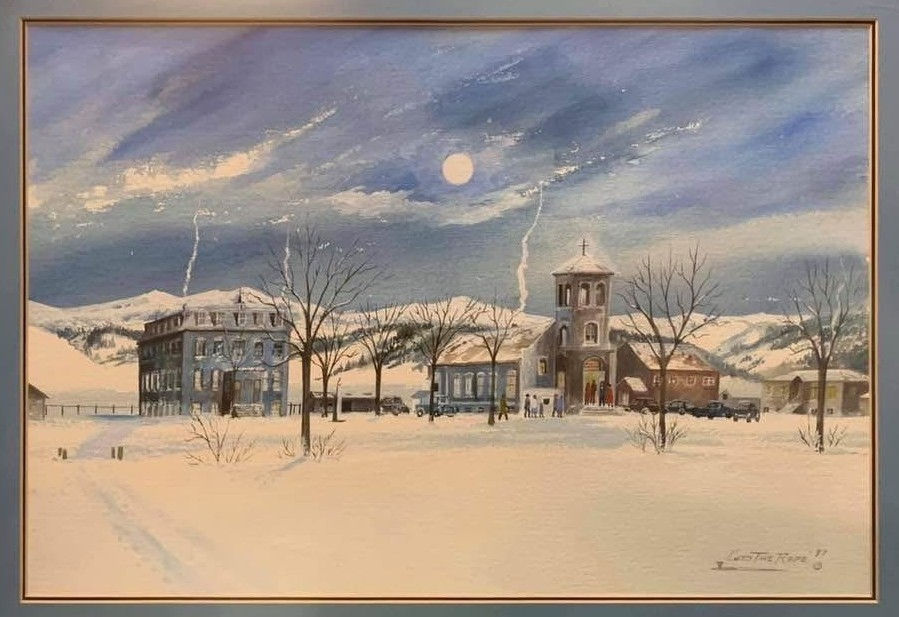
I asked an AI model to create a portrait of me in the style of Clarence Cuts the Rope. Clarence became a close friend of ours during our time in Hays. His art involved a lot of beautiful paintings, but he also did pen and ink drawings. Clearly, the AI model found his pen and ink art. May his memory be a blessing.



Comments